April 8, 2026
How to Implement VNS Therapy™ in Your Practice: Patient Selection, Surgery, and Dosing
.webp)
Written by
Will Sauvé, MD & Karen Giles, MD


VNS Therapy has been FDA approved for over 2 decades1,2 and is backed by the largest randomized controlled trial in difficult-to-treat depression (DTD).3 In the first webinar of this series, When Standard Treatment Fails, Dr. Hamish McAllister-Williams walked through the RECOVER trial results, the case for measuring quality of life and function alongside symptoms, and which patient subgroups showed the strongest benefit.
This guide covers the next question: How do you actually do it?
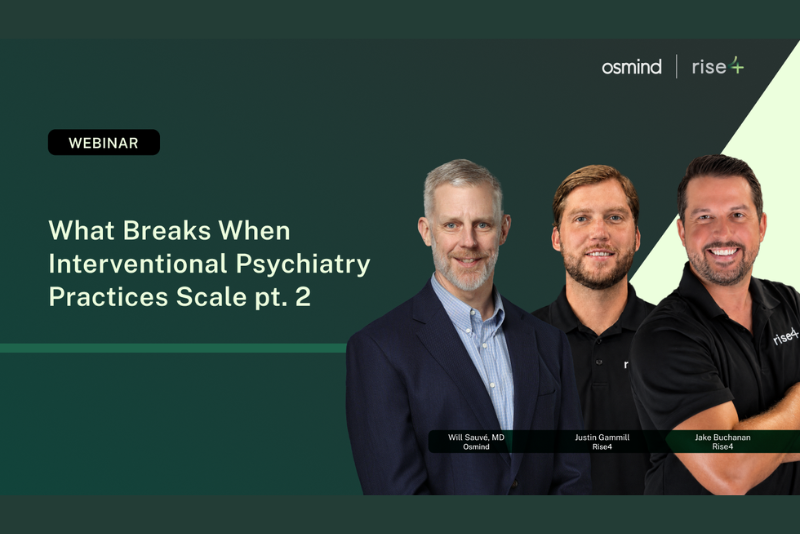
Watch the recording with Dr. Karen Giles from Breakthru Psychiatric Solutions as she walks through her real-world experience implementing VNS Therapy, from patient selection to dosing. Hosted by Dr. Will Sauvé, Chief Medical Officer at Osmind.
What You Will Learn
- Published criteria for identifying VNS Therapy candidates and when to position it in the treatment journey
- How to introduce VNS Therapy to patients and set expectations
- What the surgical procedure involves and how to dose using the SYMMETRY™ Programming System
- How VNS Therapy can work alongside TMS, ECT, esketamine, and medications
- The step-by-step pathway from patient identification through insurance authorization to ongoing care
What Is Difficult-to-Treat Depression and Why Does It Matter Here?
DTD is defined as depression that continues to cause significant burden despite usual treatment efforts.4 Under this framework, the goals broaden beyond remission to include optimal symptom control, reduced relapse risk, and improved psychosocial functioning.4 For example, VNS Therapy patients experienced clinically meaningful quality of life improvements even when MADRS reduction was only 34%—well below the 50% response threshold.5 For a deeper dive into the evidence, see When Standard Treatment Fails.
Who Could Be a Good Candidate for VNS Therapy?
VNS Therapy is indicated for the adjunctive long-term treatment of chronic or recurrent depression for patients 18 years of age or older who are experiencing a major depressive episode and have not had an adequate response to four or more adequate antidepressant treatments.6
Based on current evidence, candidates generally meet these criteria7:
- Primary diagnosis: MDD or bipolar depression, age 18+, meeting DSM-5 criteria
- Chronic or recurrent depression: Episode lasting >2 years, or 2+ episodes separated by at least 2 months
- Insufficient response to prior treatments: At least 4 adequate trials (4–8 weeks each), including medications, psychotherapy, ECT, TMS, or esketamine. Failure to respond to ECT is not a prerequisite
- Other DTD patients who may benefit: Those unable to maintain remission, those with residual symptoms on ECT or ketamine maintenance, and those on high medication doses or experiencing a high side effect burden
What Are the Specific Thresholds for Considering VNS Therapy?
McAllister-Williams et al. published additional consensus criteria8,9 that define specific thresholds for when nonstandard treatments like VNS Therapy should be considered and aims to identify that point as early as possible. For VNS Therapy, an adult patient with MDD or bipolar disorder (currently depressed), whose episode has lasted >2 years or who has had 3+ previous episodes, should be considered if they meet any one of the following:
- ECT treatment history: Response to ECT but relapsed, requiring either 2+ repeat courses in the past 2 years or maintenance ECT.8
- Service utilization: Multiple mental health admissions and/or admission >6 months.8
- Global treatment history: Failure to respond to or tolerate 2+ trials of structured psychological therapy, 4+ antidepressants at adequate doses (including 2 from clomipramine, venlafaxine [≥150 mg], escitalopram [20 mg], sertraline, amitriptyline, or mirtazapine), 2+ augmentation strategies (from lithium, quetiapine, aripiprazole), and ECT with at least 8 bilateral treatments.8
Meeting more than one criterion may indicate eligibility.8 Note: the safety and efficacy of VNS Therapy have not been shown for patients with a history of schizophrenia, schizoaffective disorder, delusional disorders, or rapid cycling bipolar disorder.6
When Should Clinicians Consider VNS Therapy in the Treatment Journey?
Patients are often on antidepressant treatments for years before VNS Therapy is proposed as an option, and response to antidepressant treatments is faster when the no-treatment interval is reduced.10 For patients with DTD who have experienced multiple pharmacological failures, there may be little value in prolonging trial and error with similar mechanisms of action.4
Because VNS Therapy is approved as an adjunctive treatment,6 it can layer onto treatment that a patient is already receiving. Dr. Giles recommended starting the prior authorization process at the initial consultation for qualifying patients even while initiating faster-acting treatments to ensure VNS Therapy is ready by the time it’s needed. Prior authorization can take approximately 6 months, so this parallel approach avoids further delay for patients who have already waited long periods of time.
How Should Psychiatrists Discuss VNS Therapy With Patients?
The initial discussion is often decisive. Dr. Giles outlined a practical framework:
- Establish candidacy clearly using published criteria to explain why this patient is a good candidate7,8
- Set expectations on a timeline. Some patients may see improvement in 6 months; for others it could take about a year, and improvements can often continue over subsequent years.7 There is currently no way to predict an individual patient’s response.11 Dr. Giles frames VNS Therapy as “an insurance policy for your depression”
- Share efficacy data. In a study of 795 patients,, approximately 70% in the VNS arm significantly improved (first-time response, P<0.001), and more than approximately 40% in the VNS arm fully recovered (first-time remission)12
- Address side effects. The most common side effects are voice alteration, paresthesia, coughing, dyspnea, sore throat, and pain and typically occur only during stimulation, become less noticeable over time for most patients, and can be managed by adjusting parameters. Patients also receive a magnet to temporarily pause stimulation.
- Direct patients to real stories at livanova.com/depression/en-us/patient-stories
What Does the VNS Therapy Surgical Procedure Involve?
VNS Therapy is not brain surgery, it is implanted through a short outpatient procedure under general anesthesia typically lasting 1 to 2 hours, and most patients go home the same day. A pulse generator (similar in size to a pacemaker) is placed in a subcutaneous pocket below the left clavicle, and a lead is attached to the left vagus nerve through an incision in the neck. The device is briefly tested intraoperatively, then turned off so that stimulation remains at 0 mA for 14 days to allow healing.6,7
How Do You Dose and Titrate VNS Therapy?
The SYMMETRY™ Programming System consists of a wireless wand and a tablet with embedded software. The wand is held over the generator site while the parameters are adjusted on the tablet.13
The standard cycle is 30 seconds on, 5 minutes off, with a 2-second ramp-up and ramp-down. Across approximately 6 visits over 3 to 6 months, output current is gradually increased (typically 0.25 mA → 0.5 → 0.75 → 1.0 → 1.25 → 1.5 mA) while signal frequency (20 Hz), pulse width (250 µs), on time (30 s), and off time (5 min) remain constant. Patient tolerability should be evaluated after each increase.6
Dr. Giles described the programming as intuitive and emphasized LivaNova provides hands-on support for new physicians. She also offered important advice: always make sure the wand and tablet are fully charged before the first patient.
Can VNS Therapy Be Used With TMS, ECT, or Esketamine?
Yes. VNS Therapy can be safely used alongside antidepressants, mood stabilizers, antipsychotics, esketamine, TMS, and ECT.4,14,15 For ECT, disabling the device during the procedure (easily done with the patient’s magnet) is a reasonable precaution. For TMS, no modifications are needed as long as the VNS generator is 30 cm outside the TMS coil placement zone.16 Patients and physicians should consult the warnings for concurrent interventions.11
What Does the Full Pathway Look Like From Referral to Ongoing Care?
Pre-approval
- Identify the patient and confirm they meet the FDA-approved indication.
- Educate the patient across 1–2 appointments.
- Initiate the PRIA process: gather patient consent forms to contact a LivaNova Patient Access Liaison (PAL), and the PRIA intake form for insurance authorization.
Post-authorization
- Access team validates authorization (0–2 days).
- Psychiatrist sends surgical referral packet (1–3 days).
- Pre-op appointment (1–3 weeks post-referral).
- Surgery scheduled (2–4 weeks post-pre-op).
- Implant procedure (1 day, typically outpatient).
- Post-op with surgeon (1–2 weeks).
- First dosing appointment with psychiatrist (2 weeks post-procedure).
- Titration over 3–6 months, then approximately quarterly appointments for ongoing monitoring and dosing adjustments as needed.
How Does Insurance Work, and How Difficult Is It to Add VNS Therapy to a Practice?
Prior authorization is typically required and can take approximately 6 months. Several commercial plans cover VNS Therapy, but coverage can vary by plan and region. Thorough documentation of treatment history is essential.
VNS Therapy does not require dedicated treatment rooms or large equipment; the entire programming system fits in a carrying case. LivaNova provides hands-on support through initial cases. Dr. Giles opened her clinic in late 2022, and while she initially didn’t plan to offer VNS Therapy, she now has five active cases. Her advice to the audience; if you’re consenting patients for interventional treatments and they meet criteria, not discussing VNS Therapy means the informed consent process is incomplete.
TL;DR
VNS Therapy is indicated for the adjunctive long-term treatment of chronic or recurrent depression for patients 18 years of age or older who are experiencing a major depressive episode and have not had an adequate response to four or more adequate antidepressant treatments.6
Multiple published consensus guidelines define which patients to consider,4,7,8,9 and ECT failure is not a prerequisite.7 Introducing nonstandard treatments, such as VNS Therapy, earlier may better serve patients with DTD.4 The procedure is a short outpatient surgery and the programming system is intuitive. VNS Therapy can be used alongside medications, esketamine, TMS, and ECT.3,6,14,15
Patients should plan for 6 to 12 months to see symptom improvements, with gains often continuing over subsequent years.7 The most commonly reported side effects from stimulation are voice alteration or hoarseness, paresthesia, increased coughing, dyspnea, sore throat, and pain. Infection is the most commonly reported complication of the surgical procedure.6
Want to learn more about VNS Therapy? Learn More.
Ready to add VNS Therapy? Connect with a VNS Therapy Representative
This webinar is selected by Osmind to be sponsored by LivaNova, PLC.
INTENDED USE / INDICATIONS
The VNS Therapy System is indicated for the adjunctive long-term treatment of chronic or recurrent depression for patients 18 years of age or older who are experiencing a major depressive episode and have not had an adequate response to four or more adequate antidepressant treatments.
The most commonly reported side effects from stimulation are voice alteration or hoarseness, increased coughing, sore throat, paresthesia, dyspnea, and pain. Infection is the most commonly reported complication of the surgical procedure.
IMPORTANT SAFETY INFORMATION
https://www.livanova.com/depression/en-us/hcp-safety-information
References
1. Berry SM, et al. Med Devices (Auckl). 2013;6:17-35.
2. Rush AJ, et al. Biol Psychiatry. 2005;58(5):347-354.
3. Conway CR, et al. Brain Stimul. 2025;18(3):676-689.
4. McAllister-Williams RH, et al. J Affect Disord. 2020;267:264-282.
5. Conway CR, et al. J Clin Psychiatry. 2018;79(5):18m12178.
6. Physician’s Manual - VNS Therapy™ Generator and Lead Manual for Depression (US), April 2025.
7. Kraus C, et al. Neuromodulation. 2022;25(3):316-326.
8. McAllister-Williams RH, et al. J Affect Disord. 2021;280(Pt A):315-318.
9. McAllister-Williams RH, et al. Br J Psychiatry. 2018;212(5):274-278.
10. de Diego-Adeliño J, et al. J Affect Disord. 2010;120(1-3):221-225.
11. LivaNova VNS Therapy™ System Depression Patient Guide (US), April 2025.
12. Aaronson ST, et al. Am J Psychiatry. 2017;174(7):640-648.
13. LivaNova Physician’s Manual VNS Therapy™ Programming System, September 2024.
14. Baweja R, et al. Am J Psychiatry. 2013;170(9):1059-1061.
15. Sackeim HA. J ECT. 2021;37(2):80-83.
16. US Food and Drug Administration. July 26, 2011. Updated March 23, 2018. Accessed April 1, 2026. https://www.fda.gov/medical-devices/guidance-documents-medical-devices-and-radiation-emitting-products/repetitive-transcranial-magnetic-stimulation-rtms-systems-class-ii-special-controls-guidance#11
DEP-2600038
Connect with forward-thinking peers, advance your practice, and attend expert events. Join the Psychiatry Collective today.
.webp)
.png)
If you, or someone you know, is in crisis or needs immediate assistance, please call 911 immediately. To talk to someone now, please call the National Suicide Prevention Lifeline at 1-800-273-8255 or 988.
Osmind © 2026 All Rights Reserved.

.webp)