September 28, 2026
Community spotlight: Why PathWave Psychiatry moved its whole revenue cycle onto Osmind
Written by
Osmind


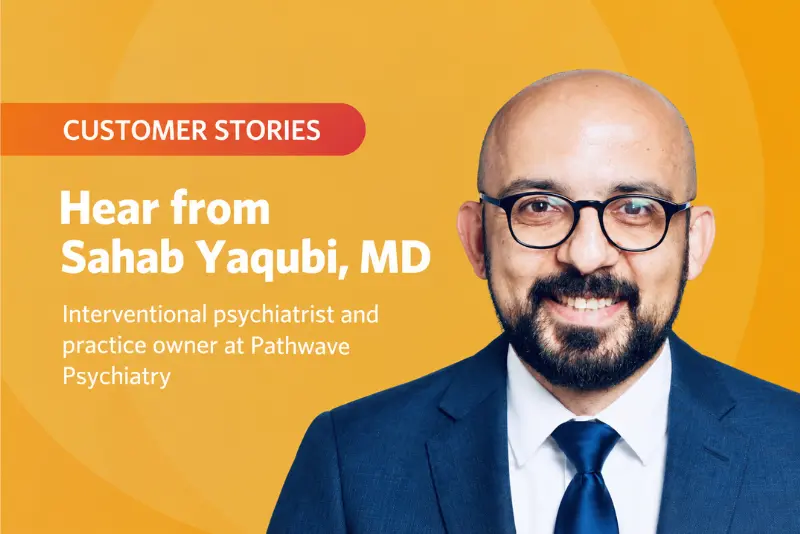
The short answer: Sahab Yaqubi, MD, oversees more than 220 interventional treatment encounters per month, as PathWave Psychiatry's only prescribing clinician. For two years his EHR and his billing lived in separate systems, connected by a clearinghouse and a shared folder. He consolidated both onto Osmind 360, and the practice now collects from payers in about 26 days against a 35-day benchmark.
PathWave Psychiatry is an Osmind customer. Operational figures in this piece are Osmind-measured.
What you'll learn
- PathWave ran Osmind One as its EHR alongside a third-party biller for two years, connected by a clearinghouse and a shared folder, which held together while the practice was small. It moved to Osmind 360, putting claims and clinical records on one platform, once growth made the split setup a scaling problem.
- Reimbursements had to be entered into the clearinghouse by hand, so Dr. Yaqubi tracked his own revenue cycle through his billing manager rather than through a dashboard.
- The practice runs more than 220 encounters a month with one prescribing clinician, a portion of them TMS courses he supervises without a visit at every session, averaging eight to nine patients a day.
- Days in A/R carries more weight for interventional practices because Spravato is purchased and administered before reimbursement arrives and TMS runs in multi-week authorized courses.
- Payer credentialing took three to six months depending on the payer, and a TMS technician takes three to four weeks of training plus a couple of months of closer supervision.
When Sahab Yaqubi, MD, opened PathWave Psychiatry in the East Bay, he did what most independent clinicians do: he picked the best tool for each job and wired them together himself.
"I chose Osmind One for just the EHR," he says. "There were several pieces of software. One was Osmind, one was the clearinghouse, and then we had a shared folder to connect our billing system with the third-party billing."
It held together when the practice was small. PathWave now runs more than 220 encounters a month with Dr. Yaqubi as its only prescribing clinician, and the billing lives in the same place as everything else. The practice collects from payers in about 26 days, ahead of the 35-day industry norm. For the first time, he can see his own revenue cycle numbers himself.
Why do psychiatrists leave group practice to open their own clinic?
Dr. Yaqubi is board-certified in both psychiatry and psychosomatic medicine, trained in consultation-liaison psychiatry at Mount Sinai, then came to the East Bay to join a large interventional psychiatry practice. The clinical work was compelling. The rest of it wasn't.
"The problem I had working with a larger practice was administration and lack of autonomy," he says. "It felt like, okay, you're doing the clinical work, but it's in a corporate setting."
What bothered him showed up in the exam room. Patients complained about billing, about scheduling, and not being able to reach anyone.. "All of that directly impacts patient treatment," he says.
So he started asking a different question: How can I make this more personal?
How do you build an insurance-based interventional psychiatry practice?
The practice he built is organized around treatment-resistant depression and anxiety, using Spravato (esketamine), Transcranial Magnetic Stimulation (TMS), and medication management, focused on people who have tried medication and psychotherapy and are still suffering.
Most of his peers leaving group practice go cash-pay. Dr. Yaqubi chose insurance, knowing how little visibility that would give him at the start.
"If you're not in the insurance world, it's a black box," he says. "There's always an ambiguity in the connection between the clinician and the payer."
“A lot of us would love to make treatment affordable for patients who are really suffering—people who have tried every modality you can imagine and are still suffering. The challenge is making sure we can work with health insurance companies effectively and efficiently”.If you’re thinking of adding insurance to your practice, Osmind offloads credentialing, so you can make more profit and impact with treatments like TMS and Spravato.
Where do interventional psychiatry referrals come from?
Dr. Yaqubi attributes much of his practice’s growth from referring clinicians: therapists first, then psychiatrists, then primary care physicians. Most of those relationships started with a shared patient rather than an introduction.
"A lot of the time I'm contacting someone about a mutual patient," Dr. Yaqubi says. "During that peer-to-peer conversation, we build a relationship that can help down the road."
The referrals come from clinicians who don't offer interventional treatments in-house. They're doing medication management, they have a patient with treatment-resistant depression, and they don't have the setup for Spravato or TMS. So they need somewhere to send them.
He's skeptical of outbound approaches, and he speaks from the receiving end of it. "Cold emails may or may not help. If I just get an email, it doesn't stick in my mind. If I see a person or talk with a person, it comes to my mind."
His actual growth strategy is slower and harder to shortcut. "At the end of the day it's patient care. You're providing a service, so it goes into the category of business. If you provide a good service, you get more positive feedback, and then you become better known in your community."
We put together a referral guide for your practice here.
How does a solo prescribing clinician run 220 cases a month?
Dr. Yaqubi is quick to put that number in perspective. There are more than 220 encounters per month. A portion are TMS courses he supervises without being in the room for each session. He sees eight or nine patients a day on average.
What makes it work clinically is his TMS technician.
"You get a technician you can trust, because they are providing the treatment on a daily basis," he says.
For anyone building that role from scratch, he estimates, "It takes up to three or four weeks of training, then closer supervision for a couple of months. Once you feel you can trust them, you move forward." A second technician started this month.
What that volume asks of the billing side is a different question. More than 220 encounters a month means hundreds of prior authorizations, follow-ups, and extensions, and none of that work sits with Dr. Yaqubi or his technicians.
What goes wrong when your EHR and your biller are separate systems?
For his first two years, PathWave ran on Osmind One, Osmind's software-only psychiatry EHR, with billing outsourced to a third-party revenue cycle company. Clinical documentation lived in the EHR. Claims lived with the biller. A clearinghouse and a shared folder connected the two.
He's clear that the biller served him well. "They were pretty good and on top of it."
The friction wasn't about their work. It was about what happens when the clinical record and the claims record live in two places that don't talk to each other, and information has to be carried across the gap by hand.
"When a reimbursement came in, they had to manually put it into the clearinghouse so I could see it," he says. "A lot of things can get missed when you're working with insurance and there are third-party companies in between."
The practical effect: Dr. Yaqubi understood his own revenue cycle through his billing manager rather than through a dashboard. "I was just trusting my billing manager to make sure we were on top of it."
The trust was well placed. The problem was that trust was the only instrument he had.
"The clinic was on the verge of taking on more patients. I thought, if it's like this now, we're going to need a better system."
Why did PathWave move from Osmind One to Osmind 360?
Osmind was expanding into revenue cycle services at the same moment Dr. Yaqubi decided he needed it, so he moved onto Osmind 360 as an early customer with no reference to call.
Part of what made that decision possible was the existing relationship. "I've had a good relationship with the founders at Osmind. Over time that built trust. They have this vision, they're highly qualified, and they can do it."
The rest was recognizing that Osmind was working on the specific thing that keeps clinicians from starting their own practices.
"There's a complete focus on interventional psyhciatry," he says. "They know the population they serve, they know what they want to make better, and they know what's missing for the clinicians who want to have their own practice. There is a fear, what's going to happen if I start? What if this goes wrong? Osmind understood that fear, or what the problem is. And they've been focused on resolving it. That's where the trust comes from."
He has been on Osmind 360 for four months, and he keeps his assessment inside that window. "So far in four months, the experience has been very positive."
What improves when billing and clinical records live on one platform?
The first change was structural. "The problem was that there were several systems. Here it's all one." Less logins and handoffs reduce time ensuring each tool and service communicate.
The second was visibility. Under the old setup, Dr. Yaqubi knew his net collection rate the way most independent practices know theirs: as a figure someone reported to him.
"Before, I was told we were at 95 to 97 percent. But I could never see it," he says. "That was trust between me and my billing manager. She was telling me the numbers looked good."
Now it's in front of him. "There's a part of the Osmind platform that shows me exactly what's happening. That's more trustworthy."
Why does days in A/R matter more for Spravato and TMS practices?
PathWave Psychiatry currently collects from payers in an average of 26 days, against a 35-day benchmark. Days in accounts receivable measures the average time between submitting a claim and getting paid.
For an insurance-based interventional practice, that figure carries more weight than it would for a medication management clinic. PathWave administers Spravato as a buy-and-bill medication, so the practice purchases the drug and administers it before any reimbursement arrives. TMS runs in multi-week courses, each with prior authorizations and extensions attached. Every day a claim sits unpaid is a day the practice is financing treatment out of its own working capital.
Across more than 220 cases a month, collecting inside of 26 days is what makes it possible to plan an expansion rather than wait on one.
Does interventional psychiatry billing need a specialized platform?
Dr. Yaqubi isn't guessing when he compares options. He researched this market twice, once when he hired his original third-party biller, and again when he was looking for an all-in-one solution.
Interventional psychiatry billing is not generic medical billing.
"If you want to work in this niche, it requires a lot of background," he says. "It's prior authorization, following up on prior authorization, extensions and expirations, all the things you have to do for TMS and for Spravato. There's a lot to stay on top of."
Generic billers can process claims. What they can't do is hold the whole interventional workflow in one place, where the authorization, the treatment course, and the claim are all part of the same record.
"If you're doing simple billing, that's another story. But if you're doing all of it together, like our practice where having the EHR, billing, and authorization workflows integrated in one platform has been a significant improvement.”
What's next for PathWave Psychiatry?
Dr. Yaqubi is planning to add a clinician and expand into the space next door. He's also preparing for psychedelic treatments if and when they become approved.
"We have the setup for that, for observation," he says. "I'm aware of medicines in the pipeline, and I've had conversations with those companies. If it works logistically, I'm very interested."
For a solo prescribing clinician running interventional treatment on insurance, the practice holds together because the administrative weight sits somewhere other than on him, and because he can see what it's doing.
Interventional psychiatry billing isn't general medical billing. Prior authorizations, extensions and expirations, and the economics of buying a drug before reimbursement arrives all have to work in one place, or none of them work. See how Osmind's revenue cycle team handles it.
Connect with forward-thinking peers, advance your practice, and attend expert events. Join the Psychiatry Collective today.
.png)
.png)
.webp)
If you, or someone you know, is in crisis or needs immediate assistance, please call 911 immediately. To talk to someone now, please call the National Suicide Prevention Lifeline at 1-800-273-8255 or 988.
Osmind © 2026 All Rights Reserved.

.webp)
