September 11, 2026

Where Is Your Psychiatry Practice Losing Revenue?

Written by

Will Sauvé, MD

Psychiatry grew up faster than the infrastructure underneath it, and your practice pays for it

Psychiatry spent a century as a talking specialty and about twenty-five years becoming a procedural one. In September 2026, interventional psychiatry got its first formal definition in the literature, published in Nature Mental Health. Psychedelics are in late-stage trials. The field is moving faster than the infrastructure required to run a profitable interventional practice, and your practice absorbs the difference.

THE SHORT VERSION

If you run Spravato or TMS at volume, you're delivering procedural medicine with software and services built for a different version of psychiatry.

At low volume, the gaps are manageable. Someone remembers the workaround. Someone checks the spreadsheet. Someone knows which claim needs attention.

Then your practice grows. Another clinician. Another payer. Another treatment room. Another location. Another modality.

The workarounds, revenue gaps, and administrative hours grow with it. Eventually that shows up in places that never appear on an invoice: aging A/R, unused treatment capacity, compliance gaps and clawbacks, delayed starts, duplicated documentation, and under-collected claims.

See where your practice is losing capacity and revenue

So, how did we get here?

Psychiatry is approaching its precision oncology moment

The simple serotonin-deficiency explanation gave way to something narrower: specific circuits, new mechanisms of action, treatment that is starting to feel individualized. Oncology reorganized the same way once measurement caught up. What looked like one disease turned out to be hundreds, each with its own right answer. Interventional cardiology took 22 years to go from the first coronary angioplasty in 1977 to a board-certified subspecialty in 1999.

For a specialty long treated as medicine's afterthought, this is the most exciting moment in a generation. It's also a different job than the one your systems were designed around.

We just defined intervetntional psychiatry in Nature Mental Health; you can learn more here.

What are the unique operational challenges inverventional psychiatry practices face?

TMS, Spravato, VNS, and the psychedelic treatments now in trials give your practice a way to expand on the strongest available evidence. For patients who have tried everything else, that's real progress. It also creates a different kind of practice.

When you deliver treatment in your office, you carry monitoring, consent, REMS, intake, documentation, reimbursement, physical space, scheduling, staffing, drug acquisition, and prior authorization requirements that medication management practices were never built to handle at this scale. The job changed faster than the infrastructure, and that reaches your P&L.

The trouble starts precisely when things go well. How does growth gets expensive in interventional psychiatry?

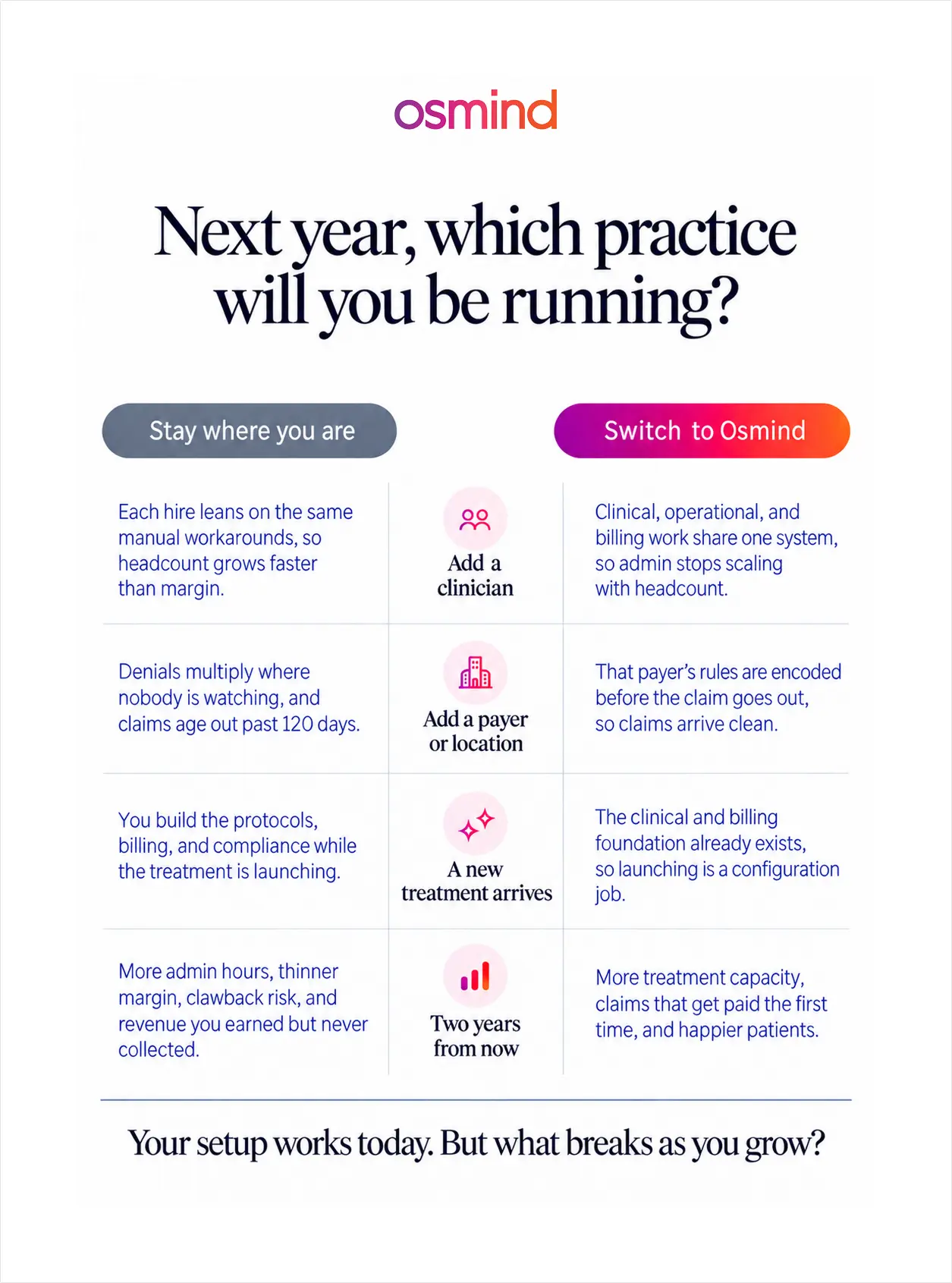
Add a location. Add a fourth and fifth clinician. Take on two more payers. Bring on a second modality. Every addition puts weight on connections you built by hand, and the handoffs start competing for the same people's time.

  • A biller collecting 70 cents of every dollar, and calling it done.
  • Reporting that can't tell you today's revenue against payroll, so you learn how the month went after it ends.
  • REMS handled by fax and documented twice, because the chart and the monitoring form have no idea the other exists.
  • A team re-entering the same patient into four places.

At two clinicians and one location, somebody knows where the gaps are and steps over them. Nothing is technically broken, so changing systems feels like more trouble than it's worth.

That's when growth turns expensive. More patients means more eligibility checks, more prior auths, more documentation, more coordination, and more places for money and hours to disappear. Everything between the referral and the chair becomes a bottleneck, so the chair sits empty while a patient waits. Most practices arrive here without noticing, because nothing visibly breaks. Growth just gets heavier, margin gets thinner, and nobody can point at the reason.

What you learned What's true now
"Nothing out there is built for me, so I'll build it myself." Accurate for twenty years, and it's why your practice exists. But every clinician, location, payer, and modality you add is one more dependency held together by memory. Self-reliance has a ceiling you can't see from underneath.
"Billing vendors are basically interchangeable, so compare on rate." You've used two or three and none were memorable, so the conclusion was reasonable. But rate and result are different measurements. A vendor at 7% who collects 70% leaves more money behind than a partner at 10% who collects 95%. The percentage is your fee. It says nothing about where the pursuit stops.
"Lower cost means more profit." Cost is the only number printed on the page in front of you. Collections require someone to go look. Many owners can't state their net collection rate offhand, which is exactly the condition under which money leaves quietly.
"Interventional treatment is better medicine but not worth the complexity." The upfront costs are real: hardware, drug acquisition, observation space. But a 15-minute medication visit reimburses roughly $130 and consumes 15 minutes of your time. Spravato and TMS reimburse $210 to $250 and free that hour once you've signed off, because a trained technician delivers the treatment.

Two years from now: the cost of staying put with your current psychiatry practice setup

You've seen this pattern in your own treatment rooms. A patient arrives with a coping strategy that was adaptive at twenty-four and has calcified into a constraint at thirty-four. You don't tell them they're broken, and you don't reach for a fifth medication trial after four have failed. You tell them the strategy was built for a context that no longer exists, and you offer an intervention.

Your practice has an operational version of treatment resistance. A profitable practice can still be capped by the systems that got it from zero to one.

So: if you added two clinicians and another treatment line next year, what else would you have to add just to support them? If the answer includes another biller, another administrator, another spreadsheet, and more hours from the practice owner, the infrastructure is already telling you something.
The fastest way to find out where you stand today

One number does more diagnostic work than anything else here.

What is your net collection rate? Of every dollar you were contractually owed, after legitimate write-offs, how many actually arrived?

Many practice owners can't answer that. When we ask on a call, the answer is usually "I'd have to check" or "my biller handles that." Both are reasonable. Both are also the exact conditions under which money disappears quietly, because a percentage-based vendor has no reason to volunteer the number that reflects worst on them.

Three questions to ask your biller

  1. My net collection rate for the last twelve months.
  2. An aging report split into 30, 60, 90, and 120-plus day buckets.
  3. At what point do you stop working a claim?

If your book is mostly Medicaid or Medicare, add a fourth: how often do you re-verify eligibility, and what happens when a patient loses coverage mid-course?

99.1%
First pass resolution rate

Claims paid on the first submission. This is the number that produces the other three.

99.4%
Net collection rate
26.7
Days in A/R
5.6%
A/R over 60 days

One interventional psychiatry practice running Spravato and TMS, roughly four months after go-live. Anonymized customer reporting, not a modeled projection.

Your net collection rate tells you a gap exists. The next question is where? Audit these six places

An 80% net collection rate is a symptom, and you know the importance of differential diagnosis. Sometimes the cause is a single payer you were never fully enrolled with, and the pattern was sitting in your denial reasons for a year.

A tooling problem, a credentialing problem, and a vendor-effort problem all show up as the same percentage. Each one has a different fix, and the six sections below are the places we find it.

1Why claims die, and when nobody tells you

Do you know the day your claims stop being pursued?

Today

Your claims go out one at a time. Denials surface when somebody happens to dig. Past a certain age, nobody is really working them.

What it should be

Batch submission, clean-claim prep, and denial reasons in one view. Expected reimbursement against your own fee schedule, by treatment and clinician, before the month closes.

What the gap costs: The spread between a 70% and a 95% net collection rate. On $2.5M in charges, that's roughly $625,000 a year on work you already did.

2REMS done twice

How many times does one Spravato session get documented?

Today

Your clinician charts the session. Then someone types the same information onto a patient monitoring form and faxes it. Nobody can tell you at a glance which patients are current, so you find out at audit.

What it should be

Captured once, in the chart, and the REMS documentation populates from it. Consent and registration trigger automatically across facility, clinician, and patient. No wasted time with double-documentation and no clawbacks

What the gap costs: Roughly 20 hours and $12k per clinician per month transcribing information you already recorded, plus recoupments and clawbacks on revenue you already collected. Lose certified status and the treatment line stops entirely.

3Buy and bill you avoid

Are you avoiding buy and bill for the margin, or the uncertainty?

Today

You'd offer Spravato buy and bill, but fronting drug cost without knowing what comes back is risk you can't absorb. So the line stays small, or stays on paper.

What it should be

Benefits verified and prior authorization cleared before you administer, so you know what you'll collect before you're out of pocket. Group purchasing handles acquisition cost.

What the gap costs: A treatment line that never reaches volume. Every eligible patient you route elsewhere is drug margin you don't capture and an interventional slot you don't fill. Not knowing what you'll collect before you administer is what stands between your practice and that margin.

4Rooms you can't book

Can you book the room, or only the clinician?

Today

Your calendar assumes one clinician, one patient, one slot. It has no concept of an observation room or a TMS chair, so utilization gets managed by whoever knows the building best.

What it should be

Multi-location scheduling where a Spravato room or a TMS chair books like any other resource, and intake populates the chart instead of getting re-typed.

What the gap costs: The fourth and fifth clinician arrive and add overhead instead of margin, at the point where growth should accelerate. The bottleneck is invisible until you're already in it.

5Revenue that never gets billed

What does the wait look like from the patient's side?

Today

Prior auth drags and the patient loses momentum before treatment starts. No record access, so they call the front desk for everything. Follow-ups get dropped between visits because nothing prompts them.

What it should be

Faster prior auths so treatment begins while the patient is still motivated. A patient app for records, messaging, and follow-ups. Measurement-based care with rating scales that graph outcomes automatically.

What the gap costs: A patient who drops out before the first session is a course of treatment that never happened. A session nobody attended is a session you can't bill, which sits entirely outside your net collection rate since NCR only measures what you billed. No-show fees rarely recover it.

6Psychedelic readiness

If the next modality were approved next quarter, could you run it?

Today

You start building at approval. Protocols, space, documentation, patient access, and reimbursement pathways all go up under time pressure while someone else is ready to treat patients.

What it should be

Your clinical, compliance, and reimbursement foundation already exists, so a new modality is a configuration question rather than a rebuild.

What the gap costs: Arriving second to every treatment on that timeline. Psychedelic therapies are in late-stage trials now, so now is the time to prepare.

Let's look at a real practice case study

An Osmind customer with twelve clinicians and two locations, running Spravato, TMS, medication management, and psychotherapy at 1,500 to 1,800 visits a month. By every outward measure, a thriving practice.

They were collecting about 70% of what they had earned on roughly $2.5 million in annualized charges. Close to a third of their insurance balances sat past 120 days, in the bucket their vendor had stopped pursuing.

Amount
Annualized charges $2,500,000
Collected at ~70% $1,750,000
Collected at a 95% benchmark $2,375,000
Revenue already earned, not arriving ~$625,000/yr

What closing the gap looks like

Elevate Wellness & Psychiatry, Pierre, South Dakota

Cassi Heuer, PMHNP-BC, founder. A town of 14,000, roughly 200 miles from the nearest major city. Medication management, Spravato, and TMS.

"A lot of people come in, the financial stress is a huge part of why their mental health isn't great. Seeing them and then having them walk out and saying, 'Oh, by the way, we need to collect your bill,' was very difficult for us. Having it all in one place, the claims, the organization, all outsourced, was so important."

Cassi Heuer, PMHNP-BC. Read the full story

220%+ Growth in monthly appointment volume
~10 hrs/week Reclaimed from billing and claims
2 evenings/week Saved on billing, claims, and prior auths

Why do disconnected tools make your psychiatry practice lose money?

Your instinct is to buy the best tool for each problem. A scheduling tool. A compliance tool. A billing vendor. A reporting layer. Assemble six competent tools and you get six logins, plus the work of keeping them in agreement. That work lands on you and your staff.

"An ounce of prevention is worth a pound of cure." Preventing a denial and the arduous task of appealing one are different businesses. An appeal needs persistence. Prevention needs the payer's rules for interventional psychiatry encoded before the claim goes out: which modifier this plan wants on a Spravato administration code, which states add a requirement the payer doesn't mention, which auth has to be renewed at session eight.

Separate tools can each be excellent and none of them can do that, because the rules have to know what the chart knows.

Go with the gestalt; one all-in-one psychiatry-tailored solution. Osmind captures profits that disconnected tools can't.

Osmind is the technology platform powering the largest network of interventional psychiatry practices in the country, built by psychiatrists for psychiatrists and psychiatric NPs. Nobody else in psychiatry holds the EHR, revenue cycle, network benchmarks, and research access in one place, which is why the pieces compound here and don't elsewhere.

Document once, and click to submit with integrated REMS. Chart the session, and the REMS form and the claim both draw from it. No re-typing or faxing.

See your capacity instead of guessing at it. A Spravato room and a TMS chair book like any other resource, so utilization is legible rather than a feeling you have on Friday.

Use what the network already knows. 1,000+ practices and the largest Spravato and TMS volume in the country means you can find out whether your reimbursement rate is actually poor or just feels that way.

Be ready for what's next. We've partnered with Compass Pathways to prepare practices for COMP360 and the psychedelic treatments behind it.

Across the Osmind network, practices run roughly 34% more profitable than the psychiatry average.

What to do this week

Send the three-question email to whoever handles your billing. Ask for your net collection rate, your aging buckets, and the day they stop working a claim.

An NCR at or above 95% usually signals a strong revenue cycle. It's still worth asking where the remaining points sit, because a gap concentrated in one payer or one workflow is the recoverable kind, and a well-run practice often leaks in staff hours, prior auth drag, or empty chairs instead of collections.

If the number comes back nearer 80%, you've located a large amount of money you already earned. What happens next depends on how you're set up. With an in-house billing team, this is usually a tooling problem and your people aren't the issue. If you outsource, it's a question of whose economics actually collect more.

Schedule a demo with us; we'd be happy to run the numbers with you.

Key takeaways:
  • Interventional psychiatry works. The infrastructre that powers it doesn't (until now with Osmind) Most EHRs were built for general medicine and sold sideways into psychiatry, and practices have been closing that gap by hand.
  • Manual workarounds work at low volume and break with growth, so the constraint arrives exactly when the practice starts succeeding.
  • Rate measures your fee. Collections measure your result. A billingvendor at 7% who collects 70% leaves more behind than a partner at 10% who collects 95%.
  • First pass resolution rate predicts everything downstream. Claims paid on first submission mean no 120-day bucket to work, which is why prevention beats appeal.

Questions we get asked

Why is running interventional psychiatry harder than running general psychiatry?

Delivering treatment in your office means carrying obligations that prescribing doesn't. You take on monitoring requirements, consent and registration steps, documentation payers audit against medical necessity, physical space to schedule, drug acquisition you may have to finance, and prior authorization that gates whether treatment starts at all. The Spravato REMS program is the clearest example: the standard workflow is still faxing patient monitoring forms and documenting the same session twice, once in the chart and once on the form. Most EHRs were built for general medicine, and the ones built for psychiatry were built for the talking version of it.

What is a good net collection rate for a psychiatry practice?

At or above 95% is what healthy looks like. Net collection rate measures what you actually collected against what you were contractually owed, after write-offs you had no right to collect. It differs from gross collection rate, which is a larger and far less useful number. Many interventional practices sit closer to 70% without knowing it.

Are psychiatry billing companies basically interchangeable?

No, and comparing them on rate hides the difference. Rate tells you your fee. It says nothing about the point at which someone stops pursuing a claim. A vendor charging 7% who collects 70% of what you earned leaves more money behind than a partner charging 10% who collects 95%. The comparison that matters is total cost to collect: your fee plus the internal staff time spent finishing work the vendor left, measured against dollars that actually arrive.

Does a Medicaid-heavy practice leak revenue differently?

Yes, and the causes are more mechanical. Commercial denials tend to cluster around medical necessity and prior authorization. Government-heavy books leak through enrollment and credentialing gaps, state-specific requirements that sit on top of the payer's own rules, and coverage that lapses mid-course without the patient or the practice knowing. That last one is the expensive one, because you keep delivering treatment and filing claims against a policy that ended. Government payer rules change less often than commercial ones and have to be published in advance, so once they're encoded correctly they hold.

What is first pass resolution rate, and why does it matter more than net collection rate?

First pass resolution rate is the share of claims paid on their first submission, with no rework, appeal, or resubmission. It matters because it predicts the other revenue cycle metrics rather than describing them after the fact. When claims are paid the first time, there is no aging bucket for anyone to work, days in accounts receivable stay under a month, and the net collection rate has nowhere to leak. A high net collection rate achieved through persistent follow-up costs staff hours that a high first pass rate never spends.

Is Spravato buy and bill profitable for a smaller practice?

Two variables decide it: what the drug costs you, and what happens to your clinician's hour. A 15-minute medication management visit reimburses roughly $130 and consumes 15 minutes of clinician time. Spravato and TMS reimburse roughly $210 to $250, and once the clinician has signed off, a trained technician delivers the treatment, which frees that hour for another patient. Group purchasing arrangements address acquisition cost. For most practices the margin works out. The binding constraint is operational: whether you can run the treatment compliantly at volume.

Connect with forward-thinking peers, advance your practice, and attend expert events. Join the Psychiatry Collective today.

Join 2,000+ clinicians
Related Blog Posts
Blog article image
What Interventional Psychiatry Gets Wrong, with Lisa Harding, MD
Read more
Blog article image
Antidepressant Sexual Dysfunction and Women's Health with Anita Clayton, MD
Read more
Blog article image
Community Spotlight: Cassi Heuer, PMHNP of Elevate Wellness and Psychiatry
Read more

If you, or someone you know, is in crisis or needs immediate assistance, please call 911 immediately. To talk to someone now, please call the National Suicide Prevention Lifeline at 1-800-273-8255 or 988.

Osmind © 2026  All Rights Reserved.

September 11, 2026

Where Is Your Psychiatry Practice Losing Revenue?

Written by

Will Sauvé, MD

Psychiatry grew up faster than the infrastructure underneath it, and your practice pays for it

Psychiatry spent a century as a talking specialty and about twenty-five years becoming a procedural one. In September 2026, interventional psychiatry got its first formal definition in the literature, published in Nature Mental Health. Psychedelics are in late-stage trials. The field is moving faster than the infrastructure required to run a profitable interventional practice, and your practice absorbs the difference.

THE SHORT VERSION

If you run Spravato or TMS at volume, you're delivering procedural medicine with software and services built for a different version of psychiatry.

At low volume, the gaps are manageable. Someone remembers the workaround. Someone checks the spreadsheet. Someone knows which claim needs attention.

Then your practice grows. Another clinician. Another payer. Another treatment room. Another location. Another modality.

The workarounds, revenue gaps, and administrative hours grow with it. Eventually that shows up in places that never appear on an invoice: aging A/R, unused treatment capacity, compliance gaps and clawbacks, delayed starts, duplicated documentation, and under-collected claims.

See where your practice is losing capacity and revenue

So, how did we get here?

Psychiatry is approaching its precision oncology moment

The simple serotonin-deficiency explanation gave way to something narrower: specific circuits, new mechanisms of action, treatment that is starting to feel individualized. Oncology reorganized the same way once measurement caught up. What looked like one disease turned out to be hundreds, each with its own right answer. Interventional cardiology took 22 years to go from the first coronary angioplasty in 1977 to a board-certified subspecialty in 1999.

For a specialty long treated as medicine's afterthought, this is the most exciting moment in a generation. It's also a different job than the one your systems were designed around.

We just defined intervetntional psychiatry in Nature Mental Health; you can learn more here.

What are the unique operational challenges inverventional psychiatry practices face?

TMS, Spravato, VNS, and the psychedelic treatments now in trials give your practice a way to expand on the strongest available evidence. For patients who have tried everything else, that's real progress. It also creates a different kind of practice.

When you deliver treatment in your office, you carry monitoring, consent, REMS, intake, documentation, reimbursement, physical space, scheduling, staffing, drug acquisition, and prior authorization requirements that medication management practices were never built to handle at this scale. The job changed faster than the infrastructure, and that reaches your P&L.

The trouble starts precisely when things go well. How does growth gets expensive in interventional psychiatry?

Add a location. Add a fourth and fifth clinician. Take on two more payers. Bring on a second modality. Every addition puts weight on connections you built by hand, and the handoffs start competing for the same people's time.

  • A biller collecting 70 cents of every dollar, and calling it done.
  • Reporting that can't tell you today's revenue against payroll, so you learn how the month went after it ends.
  • REMS handled by fax and documented twice, because the chart and the monitoring form have no idea the other exists.
  • A team re-entering the same patient into four places.

At two clinicians and one location, somebody knows where the gaps are and steps over them. Nothing is technically broken, so changing systems feels like more trouble than it's worth.

That's when growth turns expensive. More patients means more eligibility checks, more prior auths, more documentation, more coordination, and more places for money and hours to disappear. Everything between the referral and the chair becomes a bottleneck, so the chair sits empty while a patient waits. Most practices arrive here without noticing, because nothing visibly breaks. Growth just gets heavier, margin gets thinner, and nobody can point at the reason.

What you learned What's true now
"Nothing out there is built for me, so I'll build it myself." Accurate for twenty years, and it's why your practice exists. But every clinician, location, payer, and modality you add is one more dependency held together by memory. Self-reliance has a ceiling you can't see from underneath.
"Billing vendors are basically interchangeable, so compare on rate." You've used two or three and none were memorable, so the conclusion was reasonable. But rate and result are different measurements. A vendor at 7% who collects 70% leaves more money behind than a partner at 10% who collects 95%. The percentage is your fee. It says nothing about where the pursuit stops.
"Lower cost means more profit." Cost is the only number printed on the page in front of you. Collections require someone to go look. Many owners can't state their net collection rate offhand, which is exactly the condition under which money leaves quietly.
"Interventional treatment is better medicine but not worth the complexity." The upfront costs are real: hardware, drug acquisition, observation space. But a 15-minute medication visit reimburses roughly $130 and consumes 15 minutes of your time. Spravato and TMS reimburse $210 to $250 and free that hour once you've signed off, because a trained technician delivers the treatment.

Two years from now: the cost of staying put with your current psychiatry practice setup

You've seen this pattern in your own treatment rooms. A patient arrives with a coping strategy that was adaptive at twenty-four and has calcified into a constraint at thirty-four. You don't tell them they're broken, and you don't reach for a fifth medication trial after four have failed. You tell them the strategy was built for a context that no longer exists, and you offer an intervention.

Your practice has an operational version of treatment resistance. A profitable practice can still be capped by the systems that got it from zero to one.

So: if you added two clinicians and another treatment line next year, what else would you have to add just to support them? If the answer includes another biller, another administrator, another spreadsheet, and more hours from the practice owner, the infrastructure is already telling you something.

The fastest way to find out where you stand today

One number does more diagnostic work than anything else here.

What is your net collection rate? Of every dollar you were contractually owed, after legitimate write-offs, how many actually arrived?

Many practice owners can't answer that. When we ask on a call, the answer is usually "I'd have to check" or "my biller handles that." Both are reasonable. Both are also the exact conditions under which money disappears quietly, because a percentage-based vendor has no reason to volunteer the number that reflects worst on them.

Three questions to ask your biller

  1. My net collection rate for the last twelve months.
  2. An aging report split into 30, 60, 90, and 120-plus day buckets.
  3. At what point do you stop working a claim?

If your book is mostly Medicaid or Medicare, add a fourth: how often do you re-verify eligibility, and what happens when a patient loses coverage mid-course?

99.1%
First pass resolution rate

Claims paid on the first submission. This is the number that produces the other three.

99.4%
Net collection rate
26.7
Days in A/R
5.6%
A/R over 60 days

One interventional psychiatry practice running Spravato and TMS, roughly four months after go-live. Anonymized customer reporting, not a modeled projection.

Your net collection rate tells you a gap exists. The next question is where? Audit these six places

An 80% net collection rate is a symptom, and you know the importance of differential diagnosis. Sometimes the cause is a single payer you were never fully enrolled with, and the pattern was sitting in your denial reasons for a year.

A tooling problem, a credentialing problem, and a vendor-effort problem all show up as the same percentage. Each one has a different fix, and the six sections below are the places we find it.

1Why claims die, and when nobody tells you

Do you know the day your claims stop being pursued?

Today

Your claims go out one at a time. Denials surface when somebody happens to dig. Past a certain age, nobody is really working them.

What it should be

Batch submission, clean-claim prep, and denial reasons in one view. Expected reimbursement against your own fee schedule, by treatment and clinician, before the month closes.

What the gap costs: The spread between a 70% and a 95% net collection rate. On $2.5M in charges, that's roughly $625,000 a year on work you already did.

2REMS done twice

How many times does one Spravato session get documented?

Today

Your clinician charts the session. Then someone types the same information onto a patient monitoring form and faxes it. Nobody can tell you at a glance which patients are current, so you find out at audit.

What it should be

Captured once, in the chart, and the REMS documentation populates from it. Consent and registration trigger automatically across facility, clinician, and patient. No wasted time with double-documentation and no clawbacks

What the gap costs: Roughly 20 hours and $12k per clinician per month transcribing information you already recorded, plus recoupments and clawbacks on revenue you already collected. Lose certified status and the treatment line stops entirely.

3Buy and bill you avoid

Are you avoiding buy and bill for the margin, or the uncertainty?

Today

You'd offer Spravato buy and bill, but fronting drug cost without knowing what comes back is risk you can't absorb. So the line stays small, or stays on paper.

What it should be

Benefits verified and prior authorization cleared before you administer, so you know what you'll collect before you're out of pocket. Group purchasing handles acquisition cost.

What the gap costs: A treatment line that never reaches volume. Every eligible patient you route elsewhere is drug margin you don't capture and an interventional slot you don't fill. Not knowing what you'll collect before you administer is what stands between your practice and that margin.

4Rooms you can't book

Can you book the room, or only the clinician?

Today

Your calendar assumes one clinician, one patient, one slot. It has no concept of an observation room or a TMS chair, so utilization gets managed by whoever knows the building best.

What it should be

Multi-location scheduling where a Spravato room or a TMS chair books like any other resource, and intake populates the chart instead of getting re-typed.

What the gap costs: The fourth and fifth clinician arrive and add overhead instead of margin, at the point where growth should accelerate. The bottleneck is invisible until you're already in it.

5Revenue that never gets billed

What does the wait look like from the patient's side?

Today

Prior auth drags and the patient loses momentum before treatment starts. No record access, so they call the front desk for everything. Follow-ups get dropped between visits because nothing prompts them.

What it should be

Faster prior auths so treatment begins while the patient is still motivated. A patient app for records, messaging, and follow-ups. Measurement-based care with rating scales that graph outcomes automatically.

What the gap costs: A patient who drops out before the first session is a course of treatment that never happened. A session nobody attended is a session you can't bill, which sits entirely outside your net collection rate since NCR only measures what you billed. No-show fees rarely recover it.

6Psychedelic readiness

If the next modality were approved next quarter, could you run it?

Today

You start building at approval. Protocols, space, documentation, patient access, and reimbursement pathways all go up under time pressure while someone else is ready to treat patients.

What it should be

Your clinical, compliance, and reimbursement foundation already exists, so a new modality is a configuration question rather than a rebuild.

What the gap costs: Arriving second to every treatment on that timeline. Psychedelic therapies are in late-stage trials now, so now is the time to prepare.

Let's look at a real practice case study

An Osmind customer with twelve clinicians and two locations, running Spravato, TMS, medication management, and psychotherapy at 1,500 to 1,800 visits a month. By every outward measure, a thriving practice.

They were collecting about 70% of what they had earned on roughly $2.5 million in annualized charges. Close to a third of their insurance balances sat past 120 days, in the bucket their vendor had stopped pursuing.

Amount
Annualized charges $2,500,000
Collected at ~70% $1,750,000
Collected at a 95% benchmark $2,375,000
Revenue already earned, not arriving ~$625,000/yr

What closing the gap looks like

Elevate Wellness & Psychiatry, Pierre, South Dakota

Cassi Heuer, PMHNP-BC, founder. A town of 14,000, roughly 200 miles from the nearest major city. Medication management, Spravato, and TMS.

"A lot of people come in, the financial stress is a huge part of why their mental health isn't great. Seeing them and then having them walk out and saying, 'Oh, by the way, we need to collect your bill,' was very difficult for us. Having it all in one place, the claims, the organization, all outsourced, was so important."

Cassi Heuer, PMHNP-BC. Read the full story

220%+ Growth in monthly appointment volume
~10 hrs/week Reclaimed from billing and claims
2 evenings/week Saved on billing, claims, and prior auths

Why do disconnected tools make your psychiatry practice lose money?

Your instinct is to buy the best tool for each problem. A scheduling tool. A compliance tool. A billing vendor. A reporting layer. Assemble six competent tools and you get six logins, plus the work of keeping them in agreement. That work lands on you and your staff.

"An ounce of prevention is worth a pound of cure." Preventing a denial and the arduous task of appealing one are different businesses. An appeal needs persistence. Prevention needs the payer's rules for interventional psychiatry encoded before the claim goes out: which modifier this plan wants on a Spravato administration code, which states add a requirement the payer doesn't mention, which auth has to be renewed at session eight.

Separate tools can each be excellent and none of them can do that, because the rules have to know what the chart knows.

Go with the gestalt; one all-in-one psychiatry-tailored solution. Osmind captures profits that disconnected tools can't.

Osmind is the technology platform powering the largest network of interventional psychiatry practices in the country, built by psychiatrists for psychiatrists and psychiatric NPs. Nobody else in psychiatry holds the EHR, revenue cycle, network benchmarks, and research access in one place, which is why the pieces compound here and don't elsewhere.

Document once, and click to submit with integrated REMS. Chart the session, and the REMS form and the claim both draw from it. No re-typing or faxing.

See your capacity instead of guessing at it. A Spravato room and a TMS chair book like any other resource, so utilization is legible rather than a feeling you have on Friday.

Use what the network already knows. 1,000+ practices and the largest Spravato and TMS volume in the country means you can find out whether your reimbursement rate is actually poor or just feels that way.

Be ready for what's next. We've partnered with Compass Pathways to prepare practices for COMP360 and the psychedelic treatments behind it.

Across the Osmind network, practices run roughly 34% more profitable than the psychiatry average.

What to do this week

Send the three-question email to whoever handles your billing. Ask for your net collection rate, your aging buckets, and the day they stop working a claim.

An NCR at or above 95% usually signals a strong revenue cycle. It's still worth asking where the remaining points sit, because a gap concentrated in one payer or one workflow is the recoverable kind, and a well-run practice often leaks in staff hours, prior auth drag, or empty chairs instead of collections.

If the number comes back nearer 80%, you've located a large amount of money you already earned. What happens next depends on how you're set up. With an in-house billing team, this is usually a tooling problem and your people aren't the issue. If you outsource, it's a question of whose economics actually collect more.

Schedule a demo with us; we'd be happy to run the numbers with you.

Key takeaways:
  • Interventional psychiatry works. The infrastructre that powers it doesn't (until now with Osmind) Most EHRs were built for general medicine and sold sideways into psychiatry, and practices have been closing that gap by hand.
  • Manual workarounds work at low volume and break with growth, so the constraint arrives exactly when the practice starts succeeding.
  • Rate measures your fee. Collections measure your result. A billingvendor at 7% who collects 70% leaves more behind than a partner at 10% who collects 95%.
  • First pass resolution rate predicts everything downstream. Claims paid on first submission mean no 120-day bucket to work, which is why prevention beats appeal.

Questions we get asked

Why is running interventional psychiatry harder than running general psychiatry?

Delivering treatment in your office means carrying obligations that prescribing doesn't. You take on monitoring requirements, consent and registration steps, documentation payers audit against medical necessity, physical space to schedule, drug acquisition you may have to finance, and prior authorization that gates whether treatment starts at all. The Spravato REMS program is the clearest example: the standard workflow is still faxing patient monitoring forms and documenting the same session twice, once in the chart and once on the form. Most EHRs were built for general medicine, and the ones built for psychiatry were built for the talking version of it.

What is a good net collection rate for a psychiatry practice?

At or above 95% is what healthy looks like. Net collection rate measures what you actually collected against what you were contractually owed, after write-offs you had no right to collect. It differs from gross collection rate, which is a larger and far less useful number. Many interventional practices sit closer to 70% without knowing it.

Are psychiatry billing companies basically interchangeable?

No, and comparing them on rate hides the difference. Rate tells you your fee. It says nothing about the point at which someone stops pursuing a claim. A vendor charging 7% who collects 70% of what you earned leaves more money behind than a partner charging 10% who collects 95%. The comparison that matters is total cost to collect: your fee plus the internal staff time spent finishing work the vendor left, measured against dollars that actually arrive.

Does a Medicaid-heavy practice leak revenue differently?

Yes, and the causes are more mechanical. Commercial denials tend to cluster around medical necessity and prior authorization. Government-heavy books leak through enrollment and credentialing gaps, state-specific requirements that sit on top of the payer's own rules, and coverage that lapses mid-course without the patient or the practice knowing. That last one is the expensive one, because you keep delivering treatment and filing claims against a policy that ended. Government payer rules change less often than commercial ones and have to be published in advance, so once they're encoded correctly they hold.

What is first pass resolution rate, and why does it matter more than net collection rate?

First pass resolution rate is the share of claims paid on their first submission, with no rework, appeal, or resubmission. It matters because it predicts the other revenue cycle metrics rather than describing them after the fact. When claims are paid the first time, there is no aging bucket for anyone to work, days in accounts receivable stay under a month, and the net collection rate has nowhere to leak. A high net collection rate achieved through persistent follow-up costs staff hours that a high first pass rate never spends.

Is Spravato buy and bill profitable for a smaller practice?

Two variables decide it: what the drug costs you, and what happens to your clinician's hour. A 15-minute medication management visit reimburses roughly $130 and consumes 15 minutes of clinician time. Spravato and TMS reimburse roughly $210 to $250, and once the clinician has signed off, a trained technician delivers the treatment, which frees that hour for another patient. Group purchasing arrangements address acquisition cost. For most practices the margin works out. The binding constraint is operational: whether you can run the treatment compliantly at volume.

Share this

Related Blog Posts