October 7, 2026

How to fix 7 bottlenecks in your psychiatry practice, from intake to finished course
Written by

Will Sauvé, MD

How to fix 7 bottlenecks in your psychiatry practice, from intake to finished course

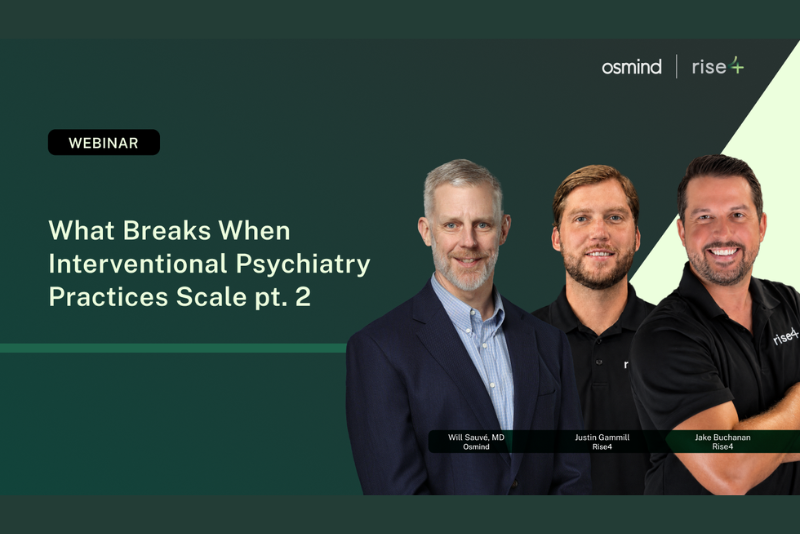
This guide is pt. 2 (pt. 1 here) of a summary from “What Breaks When Interventional Psychiatry Practices Scale,” an Osmind webinar with guest speakers, Justin Gammill and Jake Buchanan, co-founders of Rise4, a practice-growth firm, and Will Sauvé, MD, Osmind’s Chief Medical Officer. Performance figures attributed to Rise4 are internal and self-reported, and are described as such inline.

TL;DR

  • Many practices have a conversion problem in one or more areas.
  • If you measure one thing in intake, measure response time: how fast a human reaches the patient after an inquiry lands.
  • Let the weak lever dictate priority for what you fix first. Don’t apply a marketing solution to an intake problem.
  • An incomplete TMS course doesn’t just lower the odds of a durable outcome. Many payers read it as treatment failure, which can cost that patient approval for a future course.

Why do practices with the same leads get half the patients?

Across clinics running intake in-house, Buchanan said Rise4 commonly sees 3-4% of leads reach a booked evaluation on the calendar. Across Rise4’s 2025 client portfolio, the average was roughly 8%.

On 1,000 leads, that’s the difference between 30 to 40 booked evaluations and roughly 80, from the same leads, the same market, and the same ad spend.

These are observed ranges from a limited number of accounts, self-reported by Rise4, not published benchmarks.

The gap isn’t demand; adding new patients to a leaky operations bucket wastes money.

The companion guide to this one covers where to find new patients: your existing panel, your referral network, and paid acquisition.

This guide is about whether the patients you already have make it through from first inquiry to completing a course of treatment.

What should you track, and what actually matters?

Your CRM (Customer Relationship Management) is your source of truth to keep track of all your interactions with current and potential patients. Your CRM should carry the whole journey as pipeline stages, from first inquiry through last session. Most of that is staff updating a patient’s stage as they move through it, not a separate reporting project.

Track the metric listed under each of the seven stages below. “If you record nothing else, record those metrics,” Buchanan said.

You don’t need a weekly report; you need the data available when something breaks, and something always breaks.

If you can only act on one number, use response time: how fast a human reaches the patient after the inquiry lands. Everything depends on whether that first contact happened.

Where do interventional psychiatry patients drop off?

A problem in one stage usually surfaces as a symptom in the next. Let’s go through the seven gaps and how to fix them.

[IMAGE: 04-seven-bottlenecks.png] Alt text: Seven sequential bottlenecks in one patient journey: qualified opportunities, response and contact, evaluation attendance, clinical clearance, prior authorization, treatment start, treatment completion. Caption: Treat these as connected breakpoints. The weak transition exposes the constraint, and the stages around it explain the cause.

1. Qualified opportunities. Measured by: lead volume.

Before you blame intake for a low conversion rate, confirm there’s enough volume coming in and enough budget behind it. Buchanan dislikes the phrase “lead quality” and finds it mostly useless. Outside of spam, these are real people who raised a hand. The useful question is whether you reached a relevant audience and educated them well enough to self-identify.

2. Response and contact. Measured by: response time and contact rate.

This is the failure Buchanan sees most often, and it usually starts with assigning intake to a front desk or a TMS technician who’s already stretched. The role was never designed to own a specialized intake function.

Rise4’s framing is that every stage needs four things: a defined event, a primary owner, a backup owner, and a service standard.

That means deciding what actually counts as contact (a two-way conversation with the patient, not a voicemail left), naming the person responsible and whoever covers when they’re out, and setting how fast that contact has to happen. Protect that person’s time for education, scheduling, benefits, and follow-up.

Staff often resist this work because it feels like selling. The ones who’ve watched TMS or Spravato work tend to stop resisting. “You are advocating for the patient,” Buchanan said, “and you’re advocating for these life-changing treatments.”

3. Evaluation attendance. Measured by: evaluation booking and evaluation show.

No-shows often get blamed on lead quality, but Buchanan blames follow-up. Did you not follow-up at all? Or, send fifteen pages of paperwork before the patient had met anyone, or had any reason to trust you? Lead time, reminders, cost clarity, and transportation belong on the list of follow-up items, along with whether anyone confirmed the appointment.

4. Clinical clearance to start treatment. Measured by: clearance rate.

If your pre-screening works, clinical and intake shouldn’t be in conflict. When a patient shows up and can’t proceed, treat it as a near miss and ask what screening should have caught. “The list of reasons why someone might not be able to proceed to TMS or esketamine is quite short,” Sauvé said. Screening doesn’t need to be exhaustive: “You’re not trying to make every single lead into a unicorn.”

If a patient is nowhere near a payer requirement, don’t waste the patient’s time. Keep the criteria short and you’ll qualify most people without piling on friction. Gammill adds one thing: explain why you’re asking each pre-screening question. Most patients receive that well once they understand you’re trying to avoid overpromising rather than gatekeeping.

5. Prior authorization. Measured by: authorization rate and time to decision.

The strongest clinics prep the submission before the evaluation, assuming the patient will clear, then send it the same day they do. Submit only if you’ve met the payer’s stated requirements, or submit knowing you intend to appeal. Either way, submit fast.

Keep the patient informed throughout. A decision can take two weeks, and silence should never run more than a couple of days. Most patients assume their insurance will say no, so reassure them while they wait.

Track your own turnaround times, not just the payer’s. If a request takes two weeks, you need to know where the delay happened: with the payer or in your own office. One of those you can fix right away.

Prior auth workflows often break first as you expand. If one person is barely submitting one or two authorizations a week at a single site, opening a second and third caps how many patients the whole practice can start.

See also: prior auth revenue leaks guide

6. Treatment start. Measured by: treatment starts.

Between the payer’s yes and the first session, the patient still has to commit to a date, and most won’t until they know what it will cost them. So don’t rush verification of benefits to save time. Give patients a clear number early, or they’ll get the surprise later and drop out. Treatment doesn’t start until the patient is in the chair.

7. Treatment completion. Measured by: sessions completed and dropout rate.

Sauvé offered his own numbers with a caveat that they’re unaudited. Across more than a couple thousand patients, he recalls no more than about ten who stopped a course early. “Unfortunately it’s not in the Guinness Book of World Records, so nobody can go back and prove me right or wrong,” he said. A handful genuinely couldn’t tolerate treatment and stopped in week one. Most of the rest traced back to surprise bills, or to patients who didn’t understand why finishing mattered, both largely preventable with better communication.

Rise4 reports an average of 34 of 36 TMS sessions completed across its 2025 intake-side client portfolio. That’s an internal, TMS-specific figure rather than a published benchmark, and not an outcome guarantee. Read it as evidence of what high-touch communication does to a dropout rate.

Stopping at 20 sessions can lower the chance of a durable outcome, and many payers read an incomplete course as treatment failure. “Should that person ever have a desire to come back for TMS, they might not be able to,” Sauvé said. The cost of not finishing isn’t only this course. It can be the next one.

Buchanan coaches clinics to say that out loud to a patient who’s partway through and considering stopping, as information they’re owed before deciding.

How do you know what to fix first?

Don’t apply a marketing solution to an intake problem. The same stages, as a lookup you can run in a meeting:

Weak metric Where to look
Lead volumeDemand generation and online visibility
Contact rateResponse time and intake ownership
Evaluation bookingEducation, benefits, and availability
Evaluation attendanceFollow-up and barrier removal
Clinical clearanceScreening quality and clinical alignment
AuthorizationPA quality, timing, and communication
Treatment startScheduling, patient confidence, ownership
CompletionPatient experience and treatment operations

Work top to bottom: fixing an early stage raises the numbers at every stage after it.

Where to start this week

Rise4 built a Scale Readiness Toolkit for the session: a patient journey map for naming the owner and backup at each handoff, and a scorecard for grading the system you actually have.

Download your free toolkit

Run it with the people who own marketing, intake, authorizations, scheduling, and treatment operations.

“These tiny percentage increases are drastically increasing the amount of human lives that are getting access to these incredible treatments,” Buchanan said.

Your EHR and CRM are where half of the journey already gets documented. Your interventional practice loses profit and stalls due to disconnected systems not built for where psychiatry is headed.

Osmind unblocks growth with operational infrastructure 1,000+ psychiatry practices run on: credentialing, documentation, REMS compliance, revenue cycle management, group drug purchasing discounts, and psychedelic readiness in one place.

Osmind is built for practices running TMS, Spravato, and ketamine, and what comes next. See how Osmind works to unblock your practice’s revenue potential.

Connect with forward-thinking peers, advance your practice, and attend expert events. Join the Psychiatry Collective today.

Join 2,000+ clinicians
Related Blog Posts
Blog article image
Community spotlight: Why PathWave Psychiatry moved its whole revenue cycle onto Osmind
Read more
Blog article image
Your Next TMS and Spravato Patients are Already in Your Panel
Read more
Blog article image
Community Spotlight: How Amast Health Is Building for the Next Wave of Psychedelic Medicine
Read more

If you, or someone you know, is in crisis or needs immediate assistance, please call 911 immediately. To talk to someone now, please call the National Suicide Prevention Lifeline at 1-800-273-8255 or 988.

Osmind © 2026  All Rights Reserved.

October 7, 2026

How to fix 7 bottlenecks in your psychiatry practice, from intake to finished course

Written by

Will Sauvé, MD

How to fix 7 bottlenecks in your psychiatry practice, from intake to finished course

This guide is pt. 2 (pt. 1 here) of a summary from “What Breaks When Interventional Psychiatry Practices Scale,” an Osmind webinar with guest speakers, Justin Gammill and Jake Buchanan, co-founders of Rise4, a practice-growth firm, and Will Sauvé, MD, Osmind’s Chief Medical Officer. Performance figures attributed to Rise4 are internal and self-reported, and are described as such inline.

TL;DR

  • Many practices have a conversion problem in one or more areas.
  • If you measure one thing in intake, measure response time: how fast a human reaches the patient after an inquiry lands.
  • Let the weak lever dictate priority for what you fix first. Don’t apply a marketing solution to an intake problem.
  • An incomplete TMS course doesn’t just lower the odds of a durable outcome. Many payers read it as treatment failure, which can cost that patient approval for a future course.

Why do practices with the same leads get half the patients?

Across clinics running intake in-house, Buchanan said Rise4 commonly sees 3-4% of leads reach a booked evaluation on the calendar. Across Rise4’s 2025 client portfolio, the average was roughly 8%.

On 1,000 leads, that’s the difference between 30 to 40 booked evaluations and roughly 80, from the same leads, the same market, and the same ad spend.

These are observed ranges from a limited number of accounts, self-reported by Rise4, not published benchmarks.

The gap isn’t demand; adding new patients to a leaky operations bucket wastes money.

The companion guide to this one covers where to find new patients: your existing panel, your referral network, and paid acquisition.

This guide is about whether the patients you already have make it through from first inquiry to completing a course of treatment.

What should you track, and what actually matters?

Your CRM (Customer Relationship Management) is your source of truth to keep track of all your interactions with current and potential patients. Your CRM should carry the whole journey as pipeline stages, from first inquiry through last session. Most of that is staff updating a patient’s stage as they move through it, not a separate reporting project.

Track the metric listed under each of the seven stages below. “If you record nothing else, record those metrics,” Buchanan said.

You don’t need a weekly report; you need the data available when something breaks, and something always breaks.

If you can only act on one number, use response time: how fast a human reaches the patient after the inquiry lands. Everything depends on whether that first contact happened.

Where do interventional psychiatry patients drop off?

A problem in one stage usually surfaces as a symptom in the next. Let’s go through the seven gaps and how to fix them.

[IMAGE: 04-seven-bottlenecks.png] Alt text: Seven sequential bottlenecks in one patient journey: qualified opportunities, response and contact, evaluation attendance, clinical clearance, prior authorization, treatment start, treatment completion. Caption: Treat these as connected breakpoints. The weak transition exposes the constraint, and the stages around it explain the cause.

1. Qualified opportunities. Measured by: lead volume.

Before you blame intake for a low conversion rate, confirm there’s enough volume coming in and enough budget behind it. Buchanan dislikes the phrase “lead quality” and finds it mostly useless. Outside of spam, these are real people who raised a hand. The useful question is whether you reached a relevant audience and educated them well enough to self-identify.

2. Response and contact. Measured by: response time and contact rate.

This is the failure Buchanan sees most often, and it usually starts with assigning intake to a front desk or a TMS technician who’s already stretched. The role was never designed to own a specialized intake function.

Rise4’s framing is that every stage needs four things: a defined event, a primary owner, a backup owner, and a service standard.

That means deciding what actually counts as contact (a two-way conversation with the patient, not a voicemail left), naming the person responsible and whoever covers when they’re out, and setting how fast that contact has to happen. Protect that person’s time for education, scheduling, benefits, and follow-up.

Staff often resist this work because it feels like selling. The ones who’ve watched TMS or Spravato work tend to stop resisting. “You are advocating for the patient,” Buchanan said, “and you’re advocating for these life-changing treatments.”

3. Evaluation attendance. Measured by: evaluation booking and evaluation show.

No-shows often get blamed on lead quality, but Buchanan blames follow-up. Did you not follow-up at all? Or, send fifteen pages of paperwork before the patient had met anyone, or had any reason to trust you? Lead time, reminders, cost clarity, and transportation belong on the list of follow-up items, along with whether anyone confirmed the appointment.

4. Clinical clearance to start treatment. Measured by: clearance rate.

If your pre-screening works, clinical and intake shouldn’t be in conflict. When a patient shows up and can’t proceed, treat it as a near miss and ask what screening should have caught. “The list of reasons why someone might not be able to proceed to TMS or esketamine is quite short,” Sauvé said. Screening doesn’t need to be exhaustive: “You’re not trying to make every single lead into a unicorn.”

If a patient is nowhere near a payer requirement, don’t waste the patient’s time. Keep the criteria short and you’ll qualify most people without piling on friction. Gammill adds one thing: explain why you’re asking each pre-screening question. Most patients receive that well once they understand you’re trying to avoid overpromising rather than gatekeeping.

5. Prior authorization. Measured by: authorization rate and time to decision.

The strongest clinics prep the submission before the evaluation, assuming the patient will clear, then send it the same day they do. Submit only if you’ve met the payer’s stated requirements, or submit knowing you intend to appeal. Either way, submit fast.

Keep the patient informed throughout. A decision can take two weeks, and silence should never run more than a couple of days. Most patients assume their insurance will say no, so reassure them while they wait.

Track your own turnaround times, not just the payer’s. If a request takes two weeks, you need to know where the delay happened: with the payer or in your own office. One of those you can fix right away.

Prior auth workflows often break first as you expand. If one person is barely submitting one or two authorizations a week at a single site, opening a second and third caps how many patients the whole practice can start.

See also: prior auth revenue leaks guide

6. Treatment start. Measured by: treatment starts.

Between the payer’s yes and the first session, the patient still has to commit to a date, and most won’t until they know what it will cost them. So don’t rush verification of benefits to save time. Give patients a clear number early, or they’ll get the surprise later and drop out. Treatment doesn’t start until the patient is in the chair.

7. Treatment completion. Measured by: sessions completed and dropout rate.

Sauvé offered his own numbers with a caveat that they’re unaudited. Across more than a couple thousand patients, he recalls no more than about ten who stopped a course early. “Unfortunately it’s not in the Guinness Book of World Records, so nobody can go back and prove me right or wrong,” he said. A handful genuinely couldn’t tolerate treatment and stopped in week one. Most of the rest traced back to surprise bills, or to patients who didn’t understand why finishing mattered, both largely preventable with better communication.

Rise4 reports an average of 34 of 36 TMS sessions completed across its 2025 intake-side client portfolio. That’s an internal, TMS-specific figure rather than a published benchmark, and not an outcome guarantee. Read it as evidence of what high-touch communication does to a dropout rate.

Stopping at 20 sessions can lower the chance of a durable outcome, and many payers read an incomplete course as treatment failure. “Should that person ever have a desire to come back for TMS, they might not be able to,” Sauvé said. The cost of not finishing isn’t only this course. It can be the next one.

Buchanan coaches clinics to say that out loud to a patient who’s partway through and considering stopping, as information they’re owed before deciding.

How do you know what to fix first?

Don’t apply a marketing solution to an intake problem. The same stages, as a lookup you can run in a meeting:

Weak metric Where to look
Lead volumeDemand generation and online visibility
Contact rateResponse time and intake ownership
Evaluation bookingEducation, benefits, and availability
Evaluation attendanceFollow-up and barrier removal
Clinical clearanceScreening quality and clinical alignment
AuthorizationPA quality, timing, and communication
Treatment startScheduling, patient confidence, ownership
CompletionPatient experience and treatment operations

Work top to bottom: fixing an early stage raises the numbers at every stage after it.

Where to start this week

Rise4 built a Scale Readiness Toolkit for the session: a patient journey map for naming the owner and backup at each handoff, and a scorecard for grading the system you actually have.

Download your free toolkit

Run it with the people who own marketing, intake, authorizations, scheduling, and treatment operations.

“These tiny percentage increases are drastically increasing the amount of human lives that are getting access to these incredible treatments,” Buchanan said.

Your EHR and CRM are where half of the journey already gets documented. Your interventional practice loses profit and stalls due to disconnected systems not built for where psychiatry is headed.

Osmind unblocks growth with operational infrastructure 1,000+ psychiatry practices run on: credentialing, documentation, REMS compliance, revenue cycle management, group drug purchasing discounts, and psychedelic readiness in one place.

Osmind is built for practices running TMS, Spravato, and ketamine, and what comes next. See how Osmind works to unblock your practice’s revenue potential.

Share this

Related Blog Posts