June 4, 2026

TMS Works. Almost Nobody Gets It. Scott West, MD on Closing the Gap
Written by

Will Sauvé, MD

By one count, fewer than 1% of the people who could qualify for TMS, get it approved, and likely benefit from it ever actually receive the treatment. Dr. Will Sauvé cites that figure from a recent meeting of brain stimulation specialists. The FDA cleared TMS for depression in 2008, and seventeen years later, that number has barely moved.

Dr. W. Scott West had a patient - a woman around 40 who came to see him last year after three medications and a course of therapy failed her. She had grown up less than two miles from his Nashville clinic. Her mother had lived with depression her whole life, her uncle died by suicide, and her father was a surgeon. And yet, she had never heard of TMS until the week before she walked through Dr. West’s door.

"If she'd been any closer, she could have heard the machine," West said. "Still didn't know it was there.”

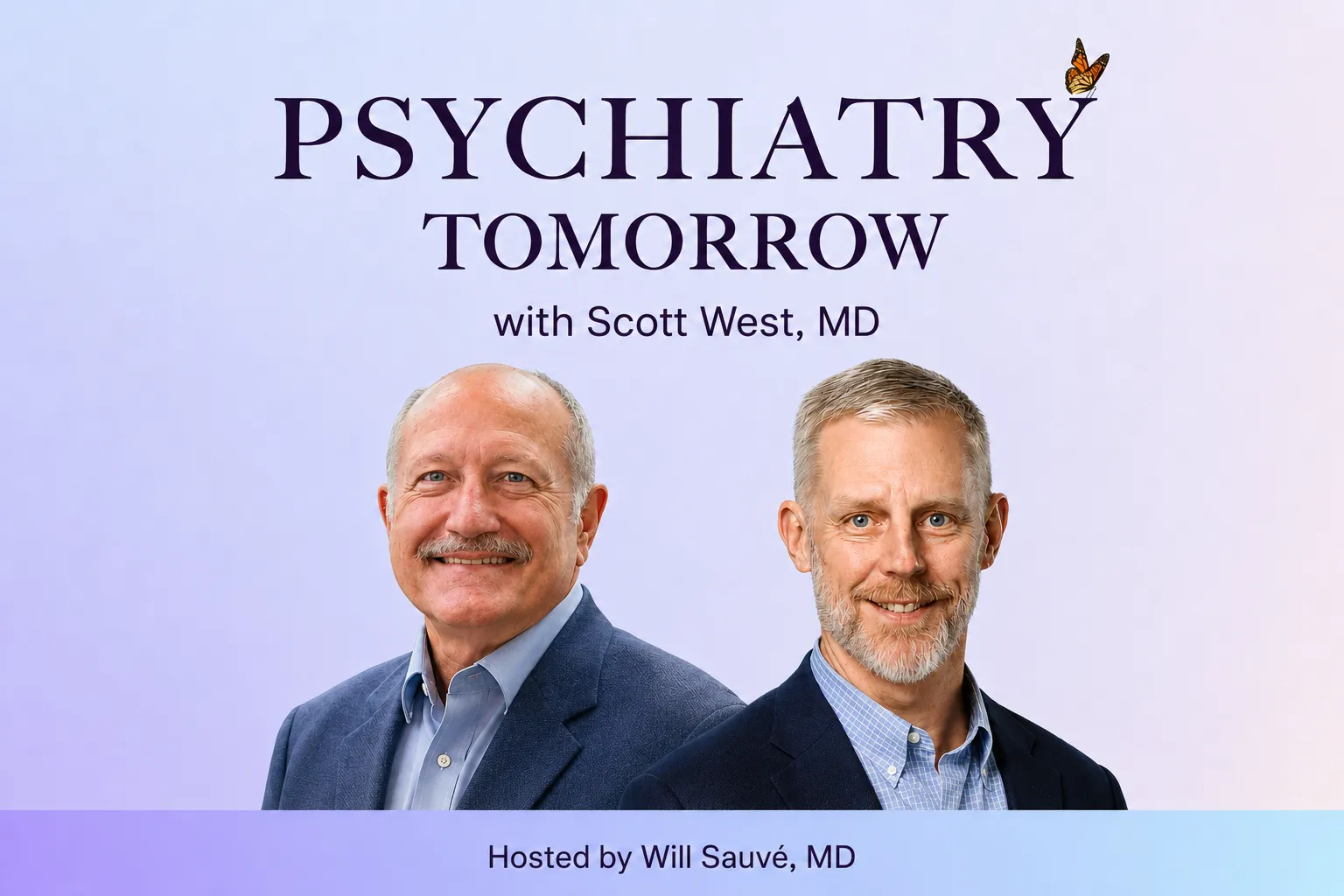
On this episode of Psychiatry Tomorrow, Osmind Chief Medical Officer Dr. Will Sauvé sat down with Dr. Scott West, the psychiatrist who brought TMS to Tennessee in 2010 and now serves as Chief Medical Officer of Nashville NeuroCare Therapy. The two have known each other for more than 15 years, and the conversation moves from how TMS arrived in the state to a pointed argument about how psychiatry treats depression, and what any clinician should know before adding neuromodulation to a practice.

In this conversation, Dr. West and Dr. Sauvé get into:

  • How TMS went from a treatment buried in academic journals to a routine outpatient option, and why so few patients still hear about it
  • Why Dr. West stopped describing TMS as a "depression treatment"
  • The case for treating depression as an urgent illness instead of something that can wait six weeks at a time
  • How to read the research and treat responsibly off-label, with two cases that stuck with both doctors
  • Where TMS is heading: QEEG-guided protocols, new brain circuits, and EEG measured under a live magnetic coil

From a Patient at Harvard to the First TMS Machine in Tennessee

The story starts in the 1990s, with a patient. One of Dr. West's patients was hospitalized at Harvard, came home, and told him about strange work a researcher named Alvaro Pascual-Leone was doing with magnetic stimulation of the brain. West paid attention. Back then, paying attention meant waiting for the next issue of the American Journal of Psychiatry, the "Green Journal," to land in his mailbox.

When TMS finally cleared the FDA, West assumed academic centers would lead. No local academic institution was pursuing it, and the treatment had actually been designed as an outpatient protocol. So in late 2009 he decided to move, and started treating patients in 2010.

One idea pushed him forward. "There was a guy named Dr. Stephen Stahl who years ago talked about the goal is remission," West said. "And that stuck with me." He had patients who got somewhat better on medication, therapy, or hospitalization but never fully well. When a new tool showed up, he took it.

Why Early TMS Looked Like It Didn't Work

Early TMS was, in Dr. West’s words, "too transparent." One of the first books he read, written by Mark George and Robert Belmaker in the 1990s, went back through every study ever done, including the ones using a few pulses, or a couple of minutes, or one to five treatments. A lot of that early literature showed TMS not working, because it was underdosed or aimed at the wrong spot.

Insurers seized on it like a reporter finding a politician’s old salactious tweet. So did some of his colleagues. The treatment got labeled “experimental.”

But we know now that TMS is one of the most evidenced-backed psychiatry treatments, let alone interventional. “You have to get to the right protocol, the right circumstances, the right patient," he said. "And then all of a sudden you find it actually does work. That's the good news. TMS works."

He and his wife ran the first year of the clinic themselves. She was his first treater. At the end of that year they reviewed every patient, and the results were strong enough that they decided to keep going and bring more people in.

Stop Calling TMS a Depression Treatment?

West doesn't think of TMS as a depression treatment.

"I really don't like to look at it in terms of, it's a depression treatment, because it is a tool that treats the brain," he said. "And when people have depressive symptoms and it's treated in the correct way, symptoms get better. And/or OCD gets better."

Sauvé pushed the idea further. The tool treats circuits in the brain, he noted, but the name of the illness we bill for says nothing about circuits. He pointed back to Stahl, who has argued that what we call depression is probably a minimum of five or ten different illnesses, and who predicted we wouldn't go long before those illnesses got their own names.

Sauvé floated a future diagnosis: frontoparietal insufficiency. A specific circuit that isn't firing right, and a tool aimed at exactly that.

"As we learn more about circuits and how they work in the brain and how to target different parts of the brain," West said, "I think we'll be able to use our tool better."

The 1% Problem / Why only 1% of patients who could benefit from TMS get TMS

Which brings us back to that woman two miles from the clinic, and the figure behind her story. The barrier isn't that prior authorization is hard to clear. By the estimate Sauvé cites, fewer than 1% of the patients who would likely clear prior authorization for TMS are getting it. They qualify on paper. They just never arrive, because they and the clinicians who could refer them don't know the option exists.

West has tried to move that number the hard way. He's given talks to NAMI, Mental Health America, Rotary, Kiwanis, the Chamber of Commerce, churches, and medical practices. He once spoke for the Clinical TMS Society at the APA. None of it seemed to do much. That frustration is what eventually pushed him onto LinkedIn to, as he puts it, start shouting from the rooftops. "We'll see if it helps."

Awareness is one wall. Cost is another. The thing that limits off-label TMS usually isn't permission. It's money.

Reading the Research: What Responsible Off-Label TMS Looks Like

The thing that limits off-label TMS usually isn't permission. It's money. Sauvé says he grits his teeth when colleagues ask whether they're allowed to do a given protocol. If you have a machine and you know how to use it, you can. The real constraint is that insurers cover what's on the label, so the moment you go off it, treatment gets expensive fast.

So West sets a different bar for himself, an evidentiary one. He'll do off-label work when there's research behind it, he'll put that research in front of the patient, and he'll make the call as a physician. "We're physicians and we make the best choices we can for our patients," he said, leaning on the evidence as much as possible.

An empowered patient is one who arrives with a credible published protocol in hand. A man with fibromyalgia and long-standing depression brought West a protocol from a group at UCLA and asked if he'd consider it. West's answer was to talk it through, call the people at UCLA, and work something out.

"It makes you one of the scariest kind of doctors in the world," Sauvé said. "A doctor who can read."

Sauvé had his own version, one of his favorite cases. A father slid a sheet of paper across the desk and asked Sauvé to consider it for his nine-year-old son, who had Tourette's. The protocol was from Columbia, written by Dr. Mantovani himself. Same logic as the fibromyalgia case: a reasonable protocol, straight from the person with the credibility to write it, so of course he'd do it. Sauvé followed it. The boy's tics came under enough control that he could go to school and function for a couple of years, and then he became one of the lucky ones whose symptoms resolved on their own. His mother sent photos to the clinic for years. They watched him grow up, go to school, play tennis.

Off-label, in both cases, meant evidence-based and physician-led. Not a guess.

Depression Is an Urgent Illness. We Should Treat It Like One.

Years ago West came across an article in the Journal of Occupational Medicine on something called presenteeism, and depression as a leading cause of it in the United States. The definition is ‘you're at work, but you're not fully functioning.’

"It's kind of like the athlete that's got a sprained ankle and can't run as fast," he said. Then he extended it past the office. You go home and the presenteeism comes with you. You don't socialize, you don't spend time with your spouse, you don't help your kids with their homework. You stay in bed. The core symptoms of depression, the lost motivation, energy, concentration, and joy, are exactly the symptoms that wreck a life and exactly the ones TMS tends to help.

Sauvé, who spent years running an inpatient unit at Naval Medical Center San Diego, framed the undertreatment in starker terms. Mania or psychosis is a four-alarm fire. Everyone runs, because it's loud and scary. Depression gets a different reflex: take this pill, check back in six weeks.

"If you have a tool that can do better, how do you think it's OK to let something drag on for six weeks, 12 weeks, 18 weeks?" he said. He used to turn to his residents and ask: you'd let your grandmother suffer like this for 18 weeks?

West's verdict was plain. "Depression is an urgent illness to deal with."

The fix isn't procedures like TMS alone. West treats it as one piece that combines with others. Medications with TMS. Psychotherapy with TMS. Ketamine or esketamine with TMS. Different forms of TMS for different aspects of mood. Get people better as fast as possible, rather than letting them struggle across months.

Related: Evaluating TMS, ECT, Ketamine, and Esketamine for MDD

What's Coming: Circuits, QEEG, and the Magic Behind the Magic

Earlier this year, West started QEEG-guided TMS, an approach that reads a patient's brain activity to personalize treatment. He's doing it, he says, to understand what's coming before it arrives.

What's coming, in his read:

  • More knowledge about specific circuits and how to reach them
  • Work on targets like the orbitofrontal cortex
  • Cheaper and easier imaging
  • Better biomarkers to tell us whether treatment is working

He suspects QEEG may be part of how the field gets there.

Sauvé has chased the imaging question for years. Patients used to ask for a functional MRI before and after, expecting to see the change. He had to explain that the technology to do that cleanly didn't exist, and that a $5,000 scan produces a pretty picture that proves very little.

But the gap is closing. He described participating in a study where an EEG signal could be captured underneath a TMS coil while the coil was running. "I got an A in physics in college," he said, "and I still don't understand how you can get a clean signal off an EEG with a one-and-a-half Tesla magnet on top of it."

For West, seeing the mechanism “doesn't destroy the magic. "There's always magic behind the magic. The more we know, the more we answer some questions, we get 10 more questions."

He's careful to keep the excitement in proportion. The field is in its relative infancy, and he tells the residents he supervises to get their seatbelts on, because it's coming fast. But he won't abandon what works to chase the new. "Standard TMS still works," he said. "I don't want to get lost in having to change too much, too quick."

Related: Portable TMS with AMPA

Advice for Clinicians Who Want to Add TMS: Don't Build a Dead Box

For psychiatrists thinking about adding TMS, West's first instruction is to build a plan, the same way he tells patients to build a strategic plan for their lives. Decide your goals. Learn the clinical application. Learn the physics. Go to a Pulses course. Then figure out how you'll actually reach patients.

He's watched the alternative play out too many times. He calls them dead boxes: a clinic buys the machine, and it never flourishes. "It's sad to see, because we know it works," he said. "But it's not something that you just put out there and it does itself. You need to be a champion of it."

Sauvé tied it back to the whole specialty. Interventional psychiatry is proactive medicine. You show up every day intending to prioritize the thing and bring it to your patients. Nobody does it for you.

TL;DR

TMS has worked for treatment-resistant depression for 17 years, yet by one estimate fewer than 1% of eligible patients ever get it. Dr. Scott West, the first physician to bring TMS to Tennessee, argues the bigger problem now is access and urgency, not efficacy. He reframes TMS as a tool that treats brain circuits rather than a single "depression treatment," makes the case for treating depression as the urgent illness it is, and shows how reading the research lets clinicians treat responsibly off-label. The near future points toward QEEG-guided protocols, new circuit targets, and better biomarkers. His advice to clinicians starting out: standard TMS still works, so build a real plan, learn the physics, and don't let your machine become a dead box.

Frequently asked questions about TMS for treatment-resistant depression

What is TMS and how does it treat depression?

Transcranial magnetic stimulation (TMS) is an FDA-cleared, noninvasive treatment that uses magnetic pulses to stimulate targeted regions of the brain involved in mood regulation. Rather than thinking of it strictly as a depression treatment, Dr. Scott West describes it as a tool that treats the brain and its circuits. When the right circuit is targeted in the right way, depressive symptoms can improve, and so can conditions like OCD.

Why do so few patients receive TMS for treatment-resistant depression?

By one estimate cited in this Psychiatry Tomorrow episode, fewer than 1% of patients who would likely qualify for TMS actually receive it. Dr. West argues the main barrier is awareness and referral rather than whether the treatment works. He points to a patient who lived two miles from his Nashville clinic for decades, in a family affected by depression, and had never heard of TMS until shortly before her first visit.

When was TMS FDA-cleared for depression?

TMS was first cleared by the FDA for major depression in 2008, and Dr. Scott West began treating patients in Tennessee in 2010. The original clearance covered high-frequency stimulation of the left dorsolateral prefrontal cortex. Newer approaches, including theta burst, accelerated protocols, and QEEG-guided stimulation, have expanded the options available since then.

Can TMS be combined with antidepressants, therapy, or ketamine?

Yes. Dr. West treats TMS as one component that combines with other treatments rather than a standalone fix. In his practice he describes using TMS alongside medications, psychotherapy, and ketamine or esketamine, and using different forms of TMS for different aspects of mood. The goal he describes is helping patients improve as quickly as possible rather than letting symptoms drag on for months.

Can TMS be used off-label for conditions other than depression?

Yes, though coverage is the main constraint. Dr. West notes that insurers generally cover on-label uses, so off-label treatment often becomes expensive for patients. He describes treating off-label when there's published research behind it, sharing that evidence with the patient, and deciding as a physician. Examples from the episode include a fibromyalgia protocol from a group at UCLA and a Tourette's protocol from Columbia.

Connect with forward-thinking peers, advance your practice, and attend expert events. Join the Psychiatry Collective today.

Join 2,000+ clinicians
Related Blog Posts
Blog article image
Compass Pathways Collaborates with Osmind to Advance Independent Clinic Readiness for Psychedelic Treatments
Read more
Blog article image
What the April 2026 Psychedelics Executive Order Means for Psychiatry
Read more
Blog article image
Osmind and CareNet GPO partner to make next-gen psychiatric treatments accessible and sustainable to independent psychiatry practices nationwide
Read more

If you, or someone you know, is in crisis or needs immediate assistance, please call 911 immediately. To talk to someone now, please call the National Suicide Prevention Lifeline at 1-800-273-8255 or 988.

Osmind © 2026  All Rights Reserved.

June 4, 2026

TMS Works. Almost Nobody Gets It. Scott West, MD on Closing the Gap

Written by

Will Sauvé, MD

By one count, fewer than 1% of the people who could qualify for TMS, get it approved, and likely benefit from it ever actually receive the treatment. Dr. Will Sauvé cites that figure from a recent meeting of brain stimulation specialists. The FDA cleared TMS for depression in 2008, and seventeen years later, that number has barely moved.

Dr. W. Scott West had a patient - a woman around 40 who came to see him last year after three medications and a course of therapy failed her. She had grown up less than two miles from his Nashville clinic. Her mother had lived with depression her whole life, her uncle died by suicide, and her father was a surgeon. And yet, she had never heard of TMS until the week before she walked through Dr. West’s door.

"If she'd been any closer, she could have heard the machine," West said. "Still didn't know it was there.”

On this episode of Psychiatry Tomorrow, Osmind Chief Medical Officer Dr. Will Sauvé sat down with Dr. Scott West, the psychiatrist who brought TMS to Tennessee in 2010 and now serves as Chief Medical Officer of Nashville NeuroCare Therapy. The two have known each other for more than 15 years, and the conversation moves from how TMS arrived in the state to a pointed argument about how psychiatry treats depression, and what any clinician should know before adding neuromodulation to a practice.

In this conversation, Dr. West and Dr. Sauvé get into:

  • How TMS went from a treatment buried in academic journals to a routine outpatient option, and why so few patients still hear about it
  • Why Dr. West stopped describing TMS as a "depression treatment"
  • The case for treating depression as an urgent illness instead of something that can wait six weeks at a time
  • How to read the research and treat responsibly off-label, with two cases that stuck with both doctors
  • Where TMS is heading: QEEG-guided protocols, new brain circuits, and EEG measured under a live magnetic coil

From a Patient at Harvard to the First TMS Machine in Tennessee

The story starts in the 1990s, with a patient. One of Dr. West's patients was hospitalized at Harvard, came home, and told him about strange work a researcher named Alvaro Pascual-Leone was doing with magnetic stimulation of the brain. West paid attention. Back then, paying attention meant waiting for the next issue of the American Journal of Psychiatry, the "Green Journal," to land in his mailbox.

When TMS finally cleared the FDA, West assumed academic centers would lead. No local academic institution was pursuing it, and the treatment had actually been designed as an outpatient protocol. So in late 2009 he decided to move, and started treating patients in 2010.

One idea pushed him forward. "There was a guy named Dr. Stephen Stahl who years ago talked about the goal is remission," West said. "And that stuck with me." He had patients who got somewhat better on medication, therapy, or hospitalization but never fully well. When a new tool showed up, he took it.

Why Early TMS Looked Like It Didn't Work

Early TMS was, in Dr. West’s words, "too transparent." One of the first books he read, written by Mark George and Robert Belmaker in the 1990s, went back through every study ever done, including the ones using a few pulses, or a couple of minutes, or one to five treatments. A lot of that early literature showed TMS not working, because it was underdosed or aimed at the wrong spot.

Insurers seized on it like a reporter finding a politician’s old salactious tweet. So did some of his colleagues. The treatment got labeled “experimental.”

But we know now that TMS is one of the most evidenced-backed psychiatry treatments, let alone interventional. “You have to get to the right protocol, the right circumstances, the right patient," he said. "And then all of a sudden you find it actually does work. That's the good news. TMS works."

He and his wife ran the first year of the clinic themselves. She was his first treater. At the end of that year they reviewed every patient, and the results were strong enough that they decided to keep going and bring more people in.

Stop Calling TMS a Depression Treatment?

West doesn't think of TMS as a depression treatment.

"I really don't like to look at it in terms of, it's a depression treatment, because it is a tool that treats the brain," he said. "And when people have depressive symptoms and it's treated in the correct way, symptoms get better. And/or OCD gets better."

Sauvé pushed the idea further. The tool treats circuits in the brain, he noted, but the name of the illness we bill for says nothing about circuits. He pointed back to Stahl, who has argued that what we call depression is probably a minimum of five or ten different illnesses, and who predicted we wouldn't go long before those illnesses got their own names.

Sauvé floated a future diagnosis: frontoparietal insufficiency. A specific circuit that isn't firing right, and a tool aimed at exactly that.

"As we learn more about circuits and how they work in the brain and how to target different parts of the brain," West said, "I think we'll be able to use our tool better."

The 1% Problem / Why only 1% of patients who could benefit from TMS get TMS

Which brings us back to that woman two miles from the clinic, and the figure behind her story. The barrier isn't that prior authorization is hard to clear. By the estimate Sauvé cites, fewer than 1% of the patients who would likely clear prior authorization for TMS are getting it. They qualify on paper. They just never arrive, because they and the clinicians who could refer them don't know the option exists.

West has tried to move that number the hard way. He's given talks to NAMI, Mental Health America, Rotary, Kiwanis, the Chamber of Commerce, churches, and medical practices. He once spoke for the Clinical TMS Society at the APA. None of it seemed to do much. That frustration is what eventually pushed him onto LinkedIn to, as he puts it, start shouting from the rooftops. "We'll see if it helps."

Awareness is one wall. Cost is another. The thing that limits off-label TMS usually isn't permission. It's money.

Reading the Research: What Responsible Off-Label TMS Looks Like

The thing that limits off-label TMS usually isn't permission. It's money. Sauvé says he grits his teeth when colleagues ask whether they're allowed to do a given protocol. If you have a machine and you know how to use it, you can. The real constraint is that insurers cover what's on the label, so the moment you go off it, treatment gets expensive fast.

So West sets a different bar for himself, an evidentiary one. He'll do off-label work when there's research behind it, he'll put that research in front of the patient, and he'll make the call as a physician. "We're physicians and we make the best choices we can for our patients," he said, leaning on the evidence as much as possible.

An empowered patient is one who arrives with a credible published protocol in hand. A man with fibromyalgia and long-standing depression brought West a protocol from a group at UCLA and asked if he'd consider it. West's answer was to talk it through, call the people at UCLA, and work something out.

"It makes you one of the scariest kind of doctors in the world," Sauvé said. "A doctor who can read."

Sauvé had his own version, one of his favorite cases. A father slid a sheet of paper across the desk and asked Sauvé to consider it for his nine-year-old son, who had Tourette's. The protocol was from Columbia, written by Dr. Mantovani himself. Same logic as the fibromyalgia case: a reasonable protocol, straight from the person with the credibility to write it, so of course he'd do it. Sauvé followed it. The boy's tics came under enough control that he could go to school and function for a couple of years, and then he became one of the lucky ones whose symptoms resolved on their own. His mother sent photos to the clinic for years. They watched him grow up, go to school, play tennis.

Off-label, in both cases, meant evidence-based and physician-led. Not a guess.

Depression Is an Urgent Illness. We Should Treat It Like One.

Years ago West came across an article in the Journal of Occupational Medicine on something called presenteeism, and depression as a leading cause of it in the United States. The definition is ‘you're at work, but you're not fully functioning.’

"It's kind of like the athlete that's got a sprained ankle and can't run as fast," he said. Then he extended it past the office. You go home and the presenteeism comes with you. You don't socialize, you don't spend time with your spouse, you don't help your kids with their homework. You stay in bed. The core symptoms of depression, the lost motivation, energy, concentration, and joy, are exactly the symptoms that wreck a life and exactly the ones TMS tends to help.

Sauvé, who spent years running an inpatient unit at Naval Medical Center San Diego, framed the undertreatment in starker terms. Mania or psychosis is a four-alarm fire. Everyone runs, because it's loud and scary. Depression gets a different reflex: take this pill, check back in six weeks.

"If you have a tool that can do better, how do you think it's OK to let something drag on for six weeks, 12 weeks, 18 weeks?" he said. He used to turn to his residents and ask: you'd let your grandmother suffer like this for 18 weeks?

West's verdict was plain. "Depression is an urgent illness to deal with."

The fix isn't procedures like TMS alone. West treats it as one piece that combines with others. Medications with TMS. Psychotherapy with TMS. Ketamine or esketamine with TMS. Different forms of TMS for different aspects of mood. Get people better as fast as possible, rather than letting them struggle across months.

Related: Evaluating TMS, ECT, Ketamine, and Esketamine for MDD

What's Coming: Circuits, QEEG, and the Magic Behind the Magic

Earlier this year, West started QEEG-guided TMS, an approach that reads a patient's brain activity to personalize treatment. He's doing it, he says, to understand what's coming before it arrives.

What's coming, in his read:

  • More knowledge about specific circuits and how to reach them
  • Work on targets like the orbitofrontal cortex
  • Cheaper and easier imaging
  • Better biomarkers to tell us whether treatment is working

He suspects QEEG may be part of how the field gets there.

Sauvé has chased the imaging question for years. Patients used to ask for a functional MRI before and after, expecting to see the change. He had to explain that the technology to do that cleanly didn't exist, and that a $5,000 scan produces a pretty picture that proves very little.

But the gap is closing. He described participating in a study where an EEG signal could be captured underneath a TMS coil while the coil was running. "I got an A in physics in college," he said, "and I still don't understand how you can get a clean signal off an EEG with a one-and-a-half Tesla magnet on top of it."

For West, seeing the mechanism “doesn't destroy the magic. "There's always magic behind the magic. The more we know, the more we answer some questions, we get 10 more questions."

He's careful to keep the excitement in proportion. The field is in its relative infancy, and he tells the residents he supervises to get their seatbelts on, because it's coming fast. But he won't abandon what works to chase the new. "Standard TMS still works," he said. "I don't want to get lost in having to change too much, too quick."

Related: Portable TMS with AMPA

Advice for Clinicians Who Want to Add TMS: Don't Build a Dead Box

For psychiatrists thinking about adding TMS, West's first instruction is to build a plan, the same way he tells patients to build a strategic plan for their lives. Decide your goals. Learn the clinical application. Learn the physics. Go to a Pulses course. Then figure out how you'll actually reach patients.

He's watched the alternative play out too many times. He calls them dead boxes: a clinic buys the machine, and it never flourishes. "It's sad to see, because we know it works," he said. "But it's not something that you just put out there and it does itself. You need to be a champion of it."

Sauvé tied it back to the whole specialty. Interventional psychiatry is proactive medicine. You show up every day intending to prioritize the thing and bring it to your patients. Nobody does it for you.

TL;DR

TMS has worked for treatment-resistant depression for 17 years, yet by one estimate fewer than 1% of eligible patients ever get it. Dr. Scott West, the first physician to bring TMS to Tennessee, argues the bigger problem now is access and urgency, not efficacy. He reframes TMS as a tool that treats brain circuits rather than a single "depression treatment," makes the case for treating depression as the urgent illness it is, and shows how reading the research lets clinicians treat responsibly off-label. The near future points toward QEEG-guided protocols, new circuit targets, and better biomarkers. His advice to clinicians starting out: standard TMS still works, so build a real plan, learn the physics, and don't let your machine become a dead box.

Frequently asked questions about TMS for treatment-resistant depression

What is TMS and how does it treat depression?

Transcranial magnetic stimulation (TMS) is an FDA-cleared, noninvasive treatment that uses magnetic pulses to stimulate targeted regions of the brain involved in mood regulation. Rather than thinking of it strictly as a depression treatment, Dr. Scott West describes it as a tool that treats the brain and its circuits. When the right circuit is targeted in the right way, depressive symptoms can improve, and so can conditions like OCD.

Why do so few patients receive TMS for treatment-resistant depression?

By one estimate cited in this Psychiatry Tomorrow episode, fewer than 1% of patients who would likely qualify for TMS actually receive it. Dr. West argues the main barrier is awareness and referral rather than whether the treatment works. He points to a patient who lived two miles from his Nashville clinic for decades, in a family affected by depression, and had never heard of TMS until shortly before her first visit.

When was TMS FDA-cleared for depression?

TMS was first cleared by the FDA for major depression in 2008, and Dr. Scott West began treating patients in Tennessee in 2010. The original clearance covered high-frequency stimulation of the left dorsolateral prefrontal cortex. Newer approaches, including theta burst, accelerated protocols, and QEEG-guided stimulation, have expanded the options available since then.

Can TMS be combined with antidepressants, therapy, or ketamine?

Yes. Dr. West treats TMS as one component that combines with other treatments rather than a standalone fix. In his practice he describes using TMS alongside medications, psychotherapy, and ketamine or esketamine, and using different forms of TMS for different aspects of mood. The goal he describes is helping patients improve as quickly as possible rather than letting symptoms drag on for months.

Can TMS be used off-label for conditions other than depression?

Yes, though coverage is the main constraint. Dr. West notes that insurers generally cover on-label uses, so off-label treatment often becomes expensive for patients. He describes treating off-label when there's published research behind it, sharing that evidence with the patient, and deciding as a physician. Examples from the episode include a fibromyalgia protocol from a group at UCLA and a Tourette's protocol from Columbia.

Share this

Related Blog Posts