November 18, 2026
Making SPRAVATO® Profitable: The Credentialing and Billing Traps Nobody Warns You About

Written by
Osmind


The short answer: If you're thinking about adding Spravato to your practice, you're probably wondering how to avoid costly mistakes, whether you already take insurance or are just getting credentialed. This guide covers how to think about credentialing vs contracting with payers, which codes to ask for on your fee schedule, the right contracting entity for your taxonomy, and a clear view of which payers allow buy-and-bill. Get those right before the first dose to prevent missed revenue.
Key takeaways
- If you’re already credentialed and contracted with a payer, adding Spravato doesn’t require new credentialing with that payer. Claims usually deny because the Spravato codes were never added to your fee schedule, so ask the payer’s contracting team (not credentialing) to add them.
- When contracting for the first time, request every code you might bill, including the G-codes, J0013, the TMS codes, and prolonged-service codes like 99417, which payers often leave off default psychiatric fee schedules.
- A backdated contract effective date isn't permission to bill. Until you're credentialed and rostered, you can't submit claims, run a verification of benefits, or file a prior authorization.
- UnitedHealthcare and Cigna commercial plans typically route Spravato through their own pharmacy benefit managers, which takes buy-and-bill off the table. Aetna and BCBS often allow it.
- Bundled G-codes usually still require a prior authorization (traditional Medicare is the main exception), so choose between bundled and unbundled billing based on reimbursement, not on PA.
You can be fully credentialed, REMS-certified, and dosing patients – and still not collect what Spravato treatment is worth. If you'd rather not worry about it, Osmind's expert interventional billing team handles everything from credentialing to prior auths and full claims processing (so you can focus on what matters and collect more).
Whether you're about to dose your first patient or six months in wondering why collections don't match your schedule, most Spravato revenue leaks happen in one of three places:
- How you're contracted
- How the drug is sourced and billed
- What your team verifies before each treatment
This article covers the first two. Part 2 (coming soon) covers the third.
Here's the full checklist to keep as a reference.
Section 1: Credentialing, Contracting, and when you can bill
Do you need new credentialing or a new contract to add Spravato?
Insurance contracting is full of jargon that gets used loosely, so a quick definition of two terms before we get into it.
Contracting is when a payer recognizes your NPI, tax ID, or entity as in-network. It's where your allowable rates – your fee schedule – get set.
Credentialing is when an individual clinician gets approved as in-network and enrolled on the payer's rosters. Some payers run the two at the same time; others do them one after the other.
When Spravato doesn't pay, it's almost always a contracting problem – and the fix depends on where you're starting. Everything below also varies by payer, by state, sometimes by individual plan. Use it as a starting point, then check your own contracts.
If you already take insurance, do you need to get credentialed or re-contracted to offer Spravato?
If you’re already credentialed and contracted with a payer, adding Spravato doesn’t require new credentialing with that payer.
What it requires is code coverage. You start offering Spravato or TMS, bill correctly, and claims deny. The reason is almost always that the CPT and HCPCS codes were never on the allowable fee schedule.
Before you dose the first patient, pull your allowable fee schedule – it's in your paper contract and often in the payer portal – and confirm you have the codes you're about to bill. For Spravato, that's the G-codes or the J-code if you're buying the drug, plus the office visit and prolonged-service codes. If you're also adding TMS, add the three TMS codes.
If they aren't there, contact the payer's contracting team to get them added – not the credentialing team.
Code coverage isn't uniform across your contracts. You can have drug codes on your physician contract and not on your nurse practitioner contract. Check coverage for every clinician type who'll be billing.
If you're contracting for the first time
The single best move is asking for more codes than you think you need.
Payers will hand you a default list. Don't accept it. Give them a list of every code you might bill, whether or not you're sure you'll use it.
Requesting the full list of psychiatric CPT and HCPCS codes on every application – the G-codes, the J-code, the TMS codes (90867, 90868, 90869), the works – costs nothing.
Two kinds of codes get missed most often: the drug codes, and the prolonged-service codes that cover the time you spend monitoring a patient after the dose. Those are 99417 and G2212. Payers don’t always include them in a standard psychiatric fee schedule, so name them explicitly.
Which one you bill depends on the payer. 99417 applies once total visit time passes 54 minutes. G2212 does the same job, but Medicare and Medicare Advantage use it at 69 minutes, and some commercial plans use it at 54.
Should you contract under medical or behavioral health?
You'll also make a medical-versus-behavioral choice here – and at some payers it isn't actually a choice. UnitedHealthcare and Cigna both route behavioral health through a separate entity (Optum and Evernorth, respectively). If your primary taxonomy is behavioral health, you can't contract with Cigna directly for medical services – you contract with Evernorth. That's workable; you can still see Cigna patients and and your claims are processed through Evernorth. But you need to know which entity you're in before you start.
Which side you land on follows from your license and the taxonomy codes you request. Some clinicians hold more than one valid taxonomy – a PMHNP who also holds a family practice taxonomy, for instance. Pick based on what's actually open. A panel may be closed for one taxonomy and open for another, or a payer may not accept mid-levels under a particular taxonomy at all.
Does being in-network mean you're covered for behavioral health claims?
Not necessarily.
Some payers don't process their own behavioral health claims – they contract that out to a third-party administrator. A clinician in-network with an Anthem plan may still need to separately contract and credential with Carelon, Anthem's behavioral health claims processor. Showing up in the Anthem directory doesn't mean the Carelon piece was ever done.
Three things make this harder than it looks.
- These arrangements vary by plan and change without much notice. Some Blue Cross Blue Shield plans process behavioral health claims themselves, while others, including Anthem plans, route them to a separate administrator like Carelon. An answer that was right six months ago can go stale.
- Eligibility and claims can also route to two different entities, which is why "I verified eligibility, so why did the claim deny?" is so common.
- Some employers carve behavioral health out to a different administrator than their medical plan entirely, so a patient's card can say one payer while their behavioral health benefit routes somewhere else.
Being "in-network" can mean something different for medical, for behavioral health, and for a specific benefit carve-out – all under the same patient's card.
When can you actually start dosing and billing?
Not when the contract is signed. You need the date your credentialing is actually live, and until credentialing and rostering are complete you won't be recognized in the payer's system for verification of benefits or prior authorizations.
The common trap is the backdated effective date. A countersigned contract often shows an effective date in the past, and you might read that as permission to bill retroactively. It isn't. Until the clinician is fully credentialed and rostered, you can't submit claims, run a VOB, or file a PA – regardless of what date is on the paper. The payer put that date there themselves.
Adding a treatment location has its own version of this. Payers need the service address on file before verifications or authorizations will work there, even for a clinician who's otherwise fully credentialed. It's a demographic update filed with each payer – not an internal change – and payers won't process it until the initial credentialing application is complete. Budget roughly another 30 days, and don't drop the old address early or see patients at the new location before it's linked.
One reassurance: Most commercial payers allow 90 to 180 days from the date of service to submit a claim, so a short wait for credentialing to finish usually won’t cause a timely-filing problem for routine visits. Spravato is the exception to plan around: commercial plans typically require an approved prior authorization before the first dose, and you can’t file one until you’re rostered. Dosing has to wait.
What should you know before credentialing through an MSO?
An MSO can take a lot of the credentialing burden off your plate. The tradeoff is you often bill under its contracts and tax ID, not your own.
For interventional treatments, that matters. You don't own the contract, so you can't get missing codes added yourself. If the MSO's contract doesn't carry the drug codes or the TMS codes, you have to ask the MSO to go get them added – and whether they will, and how fast, depends on whether interventional work matters to their business.
Here's what happens: you get REMS-certified, train staff, start dosing, and then can't collect. Not because of anything clinical. Because nobody ever added Spravato's codes to a contract you don't control.
Before you sign with any credentialing service, ask:
- Will I be credentialed under my own tax ID, or yours?
- Which entity will you credential me under, and does it match my primary taxonomy?
- Do you know which payers route Spravato through a pharmacy benefit manager instead of buy-and-bill? Have you actually negotiated G-codes or TMS codes onto a fee schedule before?
- If the codes I need aren't on your contract today, will you go get them added – and how long does that typically take you? (A yes with no timeline is a soft no.)
- Will signing with you constrain my EHR or billing choices later – and what happens to my credentialing and payer relationships specifically if I leave?
- Which specific codes are listed on the fee schedule, beyond the E/M codes that are always there by default?
- What does it take to leave – and is unwinding guaranteed clean, or just possible?
How Osmind handles credentialing and interventional revenue cycle management (RCM)
There are two ways to partner with Osmind on credentialing and billing:
Osmind 360 credentials you under your own tax ID and contracts. You keep the payer relationships; Osmind handles credentialing, getting interventional codes onto your fee schedules, and your revenue cycle. It's built for practices with 4–20 clinicians, in any state.
Osmind Care Network credentials smaller practices onto Osmind's group payer contracts, with the full set of psychiatric and interventional codes requested from the start. It's available in select states. Because you'd bill under our contracts, ask us every question on the list above, including what it takes to leave.
Both are backed by Osmind's interventional revenue cycle team – the people who work Spravato and TMS claims every day.
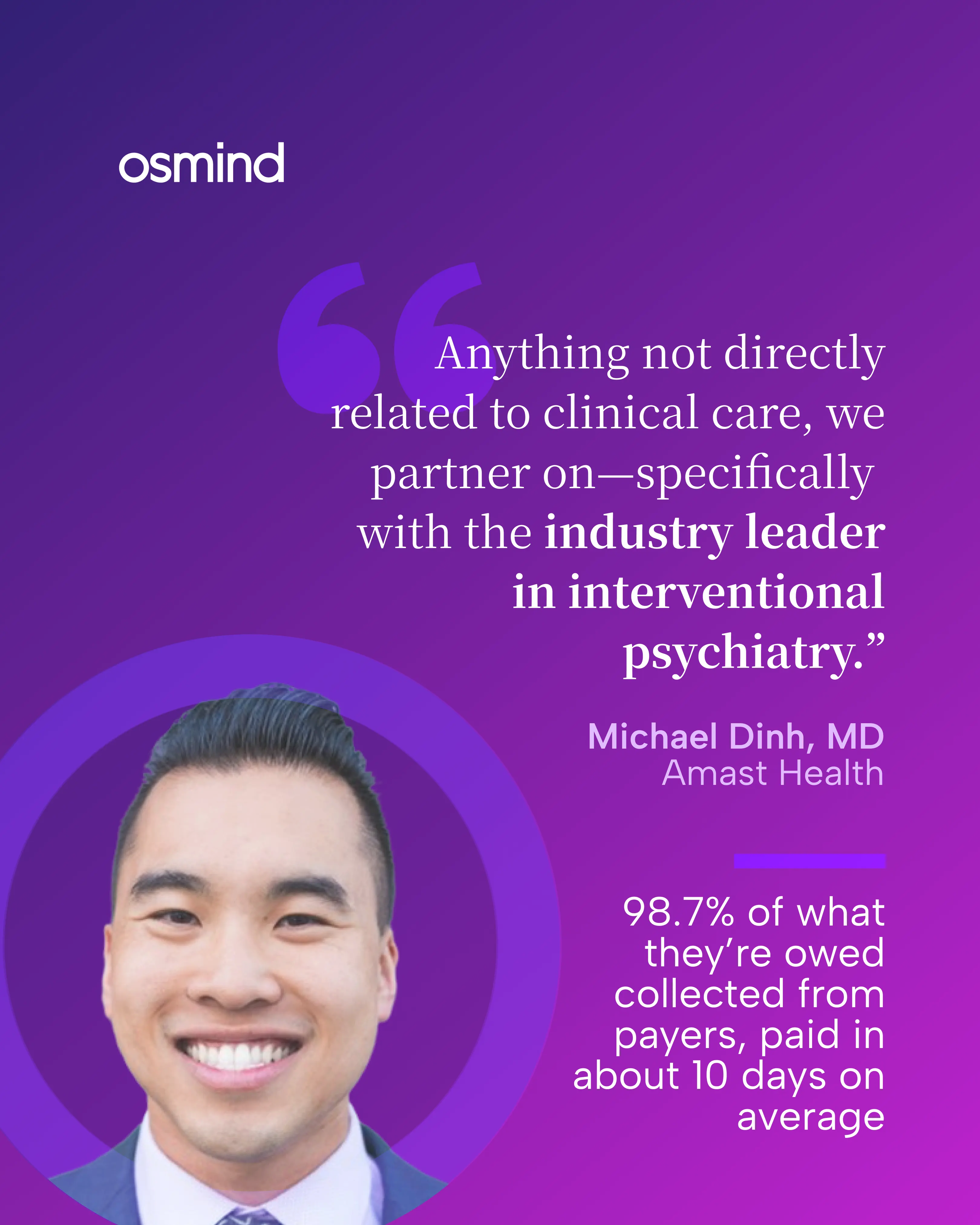
Either way, you keep 100% ownership of your practice and full clinical autonomy. Pricing is performance-based, so we only succeed when you do.
Not sure which fits your payer mix? Let's talk it through.
Should you negotiate your Spravato contracts?
Yes – and most psychiatrists never do. They sign whatever the payer offers.
If you've been running the program a while, your own data is your leverage. Don't ask for more money outright. Translate what you do into terms payers track: patient access, treatment complexity, and keeping patients out of costlier settings like the ER or inpatient. If you're negotiating a new contract, build Spravato's codes in from the start rather than coming back for them later.
If you'd rather not run contracting yourself, Osmind Care Network credentials smaller practices onto Osmind's group contracts, with Spravato's codes requested up front.
Section 2: Space and drug procurement
Do you need a dedicated space to start offering Spravato?
No. You might assume you need ten chairs, a private-room buildout, and enough Spravato in stock to make buy-and-bill worthwhile from day one. None of that is required. A single exam room is enough to take one patient from the first dose through maintenance.
Every dollar committed to space or supply before you've confirmed patient volume and payer behavior is a dollar at risk.
Should you buy-and-bill Spravato, or use a specialty pharmacy?
Buy-and-bill means you purchase Spravato from a certified specialty distributor, hold it in inventory, and bill both the drug and the administration to the payer yourself. With specialty pharmacies, a third party ships the drug to your office – never to the patient, sometimes called white bagging. You don't own the inventory, though you're still responsible for maintaining it, and you bill only for the administration.
Buy-and-bill brings in more revenue per treatment because you're billing for the drug, not just the service. Revenue isn't margin, though – you're buying the drug and carrying it. The real risk isn't dramatic: reimbursement falling below acquisition cost is rare. Margin thins instead, until stocking Spravato yourself stops being worth the operational load.
The bigger constraint is that buy-and-bill isn't always available. On their commercial plans, UnitedHealthcare and Cigna typically route Spravato through the pharmacy benefit, using the pharmacy benefit managers they own – OptumRx and Express Scripts. That's usually not a contract term you can negotiate around. If you're credentialed under a medical taxonomy rather than a behavioral health one, confirm directly with the payer before assuming it applies to you. If a payer declines to put the G-codes or J-code on your fee schedule, this is usually why.
If you do pursue buy-and-bill, ease in. Don't buy hundreds of boxes and then figure out how to move them. Once you trust a payer's contract, move a patient who's already succeeding on specialty pharmacy over one at a time, so you learn how that payer behaves before you scale. Most of the cash-flow risk disappears when you do it this way.
How can you save on Spravato costs with group purchasing discounts?
Join a group purchasing organization. A GPO pools the purchasing volume of its member practices and negotiates with distributors on your behalf – the same approach that more than 90% of hospitals use to hold down drug costs.
Buy-and-bill margin comes down to two numbers: reimbursement, which you negotiate, and acquisition cost, which you'd otherwise pay at whatever your distributor quotes. A GPO is how you negotiate the second. It only helps if you're the one buying the drug.
Osmind partners with CareNet GPO, which negotiates with Cencora (Besse Medical), the distributor handling most Spravato distribution nationally. There are no membership fees; CareNet is funded by administrative fees paid by the distributor. Membership also includes education and practice management support, plus REMS certification and facility setup guidance if you're not dosing yet.
One thing to know: pharmaceutical pricing is regulated and confidential, so you can't compare rates before signing a confidentiality agreement. If you already buy through Besse, discounted pricing can apply within days. Opening a new distributor account takes roughly 6 to 8 weeks, most of it controlled-substance documentation.
Which payers allow Spravato buy-and-bill, and which route through a pharmacy benefit?
Aetna and Blue Cross Blue Shield often allow buy-and-bill under the patient's medical benefit, though individual plans may still route the drug through a pharmacy benefit manager. UnitedHealthcare and Cigna commercial plans typically don't, for the reasons above. Medicare Advantage is a separate case – it generally uses the bundled G-codes covered below.
If the plan routes through a PBM, the bundling question below doesn't apply – there's no code choice to make, because you're not billing the drug.
If buy-and-bill is on the table, will the payer let you unbundle?
The payer and plan mostly decide this. When you do have a choice, unbundling usually pays more, but not always: some contracts carry attractive bundled rates, and rates are negotiable. If the bundled rate beats the full unbundled claim, bill bundled. Don't expect either option to spare you a prior authorization – traditional Medicare is the only payer that never requires one, and only a small subset of commercial plans pay the G-codes without one.
A bundled G-code can reimburse more than the drug code alone, because the bundle includes the administration. Compare the full bundle against the full unbundled claim – drug plus professional-service codes – not just the drug code in isolation.
Confirm benefits and prior authorization requirements for each patient before treatment. Plans under the same payer can differ – a single BCBS entity may carry dozens. Whatever is authorized for that patient is what you bill.
One place where it all connects
We built Osmind to be the one platform and team you need for the next era of psychiatry.
Credentialing, contracting, revenue cycle, and an EHR built specifically for interventional psychiatry – all in one place. Practices that get this infrastructure right now capture more profit, and add the next wave of treatments without rebuilding everything underneath.
Book a demo to see how Osmind makes sense (and cents) for your practice.
Pt 2 coming soon: Pre-Treatment Workflows and Denial Fixes that Protect Spravato Revenue
Connect with forward-thinking peers, advance your practice, and attend expert events. Join the Psychiatry Collective today.
If you, or someone you know, is in crisis or needs immediate assistance, please call 911 immediately. To talk to someone now, please call the National Suicide Prevention Lifeline at 1-800-273-8255 or 988.
Osmind © 2026 All Rights Reserved.